Finding the right air pump for motorcycles means prioritizing portability, reliable accuracy, and quick inflation. The top picks below are compact, cordless or dual-powered options that fit in a saddlebag or glove box and handle motorcycle tires efficiently. This guide highlights each model’s best use case, so you can choose the right pump for solo rides, group trips, or emergency roadside stops. The buyer-friendly table summarizing key details appears after the intro for quick reference.
| Product | Best For | Key Strength |
|---|---|---|
| AstroAI L7 Tire Inflator | Everyday motorcycle maintenance | TrueGauge accuracy, 150 PSI, compact |
| Powools Tire Inflator | Emergency kits and long trips | 3X faster inflation, 4000mAh battery |
| OlarHike Tire Inflator | Flexibility on the road | Dual power, high capacity, LED |
| Airmoto Tire Inflator | Glove box ready for quick top-offs | Auto shut-off, LCD pressure gauge |
| ROCGORLD R8 | Fast inflations for varied tires | Dual digital display, 40L/min |
AstroAI L7 Tire Inflator: Quick, Accurate, Pocket-Sized

The AstroAI L7 is a compact cordless inflator designed for motorcycles, cars, bikes, and sports balls. It uses an advanced TrueGauge sensor and a 150 PSI maximum, making it suitable for quick roadside checks and routine tire maintenance. The device includes preset smart modes for car, motorcycle, bicycle, and balls, plus multiple pressure units (PSI, Bar, kPa, kg/cm²). Its lightweight form is ideal for riders who want a reliable, one-hand operation pump for on-the-go inflation.
Best for: riders who want precise readings on the road and a versatile preset system for different inflatables. It’s especially convenient for weekend riders who prioritize speed and accuracy in a small package.
Limitation: It’s not intended for heavy-duty truck tires or oversized off-road tires, which can require higher torque and a different pump class.
Powools Tire Inflator: Fast, Long-Lasting, Cordless

The Powools inflator emphasizes speed and endurance. With a 150 PSI maximum and a high-performance motor, it inflates a typical car tire quickly, which translates well for riders who want quick checks at the side of the road. A 4,000 mAh battery provides extended operation between charges, enabling inflations for multiple tires, bikes, or balls before a recharge. A Type-C port adds charging convenience for modern devices.
Best for: riders who value rapid inflation times and long battery life for multi-tire sessions during trips or emergencies. It also suits those who want a compact, carry-anywhere solution with a dedicated storage bag.
Limitation: The claim of “2 car tires per charge” is idealized; actual performance depends on tire size and ambient conditions, and heavier tires may reduce total output per charge.
V1 Motor Portable Mini Air Compressor: Adventure-Ready
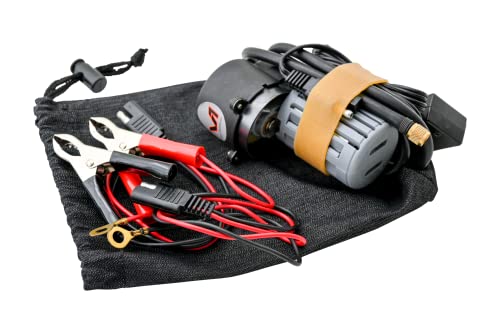
The V1 Motor is crafted for trail riders and long road trips. Its compact, lightweight design includes a 24-inch inflator hose, a 5-foot power cord, SAE connectors, and alligator clips—features that enhance on-the-go versatility. While its portability is a top selling point, the unit remains robust enough for motorcycles and other recreational vehicles, making it a practical choice for adventure enthusiasts who travel light.
Best for: motorcycle riders who frequent off-road trails or long tours and need a compact, all-in-one inflator with extended reach cables and quick inflation for a variety of tires.
Limitation: The compact size may limit peak pressure and overall tire versatility compared to larger, dedicated inflators for high-psi sport tires.
OlarHike Dual-Power Inflator: Cordless Or Car-Powered

The OlarHike inflator offers dual power options: a rechargeable 6000mAh battery and a standard 12V car outlet. This flexibility is advantageous for riders with sporadic charging access while touring or camping. It delivers rapid inflation with a claimed 51 PSI limit, which covers most car and motorcycle needs. The built-in LED and a digital pressure gauge help ensure accurate inflation in varying light conditions.
Best for: riders who want flexibility between cordless top-offs and continuous power from a vehicle cigarette lighter, especially on longer trips where charging opportunities vary.
Limitation: The unit’s maximum limit (up to 51 PSI) may be insufficient for larger or high-psi tires, and charging speed depends on the adapter used.
ROCGORLD R8: High-Speed Inflation With Dual Display

The ROCWORLD R8 refines the inflator design with a dual digital display that shows real-time and preset pressures, helping avoid over- or under-inflation. It inflates quickly thanks to a 40L/min cylinder, delivering near-instant top-offs for common passenger tires and some sport tires. The device is built for durability, includes a long power cord and a hose designed to resist kinks, and continues to provide reliable, fast inflation under a variety of conditions.
Best for: riders who appreciate precise digital monitoring and quick inflation for everyday motorcycle tires, with a focus on reliable performance in varied weather and road conditions.
Limitation: High performance comes with a larger footprint than the smallest pocket pumps; consider storage space in your bike bag when selecting this model.
Buying Guide: How To Choose The Right Motorcycle Tire Inflator
- Power Source — Decide between corded (12V car outlet) vs. cordless (built-in battery). Corded units can run indefinitely, but cordless pumps provide true on-the-go convenience for riders without easy access to a power outlet.
- Pressure Range — Most motorcycle tires sit comfortably within 30–40 PSI. Choose a pump with at least 100–150 PSI maximum for future-proofing, and look for auto shut-off at your target pressure to prevent over-inflation.
- Speed vs. Portability — A balance exists between rapid inflation and compact size. If you frequently travel light, prioritize smaller footprints and efficient inflation times. For touring with more riders, consider higher-tower models that inflate faster.
- Display and Interfaces — A clear digital gauge helps you set exact targets. Dual displays and unit options (PSI, Bar, kPa) improve usability in varied environments and with different tire types.
- Durability and Accessories — Look for robust hoses, heat-resistant bodies, and included cords or carrying cases. Features like LED lights aid inflation in dark conditions, and deflate functions help quickly adjust tire pressures.
- Best For Your Riding Style — Urban commuters may favor compact, simple units; sport riders may benefit from higher PSI capability and faster inflation; adventure riders benefit from dual power and robust hoses.
Frequently Asked Questions
- Can motorcycle tires be over-inflated with these pumps? Most units include auto-shutoff to prevent over-inflation, but always set your target PSI to the recommended level for your tire and riding load.
- Are cordless inflators safe for highway tire changes? Yes, cordless inflators are designed for roadside use, but exercise caution, use proper PPE, and avoid overstraining the tire beyond its rated capacity.
- What maintenance helps extend a portable air pump’s life? Regularly check the hose for wear, keep battery contacts clean, and store in a dry, cool place. Fully charge before long trips and avoid leaving a depleted battery unused for extended periods.
- Which pump is best for dual use with a car and a motorcycle? Pumps with dual power modes and higher PSI ranges are typically the best overall for mixed vehicle use, ensuring compatibility with tires of different sizes and pressures.
- Do these pumps work with sports balls? Many models include preset modes for balls and inflatables; always verify the PSI range and unit mode before use.
- Is a larger display always better? A larger, clearer display simplifies reading under outdoor lighting or in poor weather, reducing the chance of targeting the wrong pressure.