Answering your search for reliable exhaust back pressure gauges, this guide highlights five solid options for diagnosing turbo, catalytic converter, and muffler issues. Best for professional shop use or DIY diagnostics, these tools let you test from the driver’s seat, read precise PSI/Bar measurements, and identify blockages quickly. The top picks balance durability, ease of use, and accurate readings across common vehicle applications.
| Product | Brand | Key Benefit |
|---|---|---|
| Exhaust Back Pressure Tester Kit, Professional Diesel Engine Diagnostic Tool | DKwoeshg | 600°F hose; quick-connect; high accuracy |
| OEMTOOLS 37263 Exhaust Back Pressure Tester/Gauge Kit | OEMTOOLS | Versatile adapters; clear PSI/Bar readings |
| Exhaust Back Pressure Tester Kit with 6FT Hose | APOWFIX | 6.2 ft hose; durable; easy from driver’s seat |
| Exhaust Back Pressure Tester Kit with Quick Connector | Autory | Right-angle quick-connect; 6-ft hose; portable case |
| Exhaust Back Pressure Tester Kit for Automotive Diagnostics | MOTOCOCHE | Dual-unit readouts; durable hose; clear red zone indicator |
Exhaust Back Pressure Tester Kit, DKwoeshg

Best for turbocharged engines and extended diagnostics, this kit includes a 6 ft, double braided stainless steel hose that withstands up to 600°F/315°C. It uses a push-to-lock quick-connect for one-handed operation, saving installation time and fitting into tight spaces. The gauge is factory calibrated to ±0.5% and shows PSI and bar with a multi-color band for idle and 2,500 RPM readings.
Who it’s for: diesel technicians and advanced hobbyists who need fast setup and high-temperature endurance. Limitation: the kit’s high temperature capability may be more than needed on mild engines, adding cost for basic apps.
OEMTOOLS 37263 Exhaust Back Pressure Tester

Best for varied vehicles due to its oxygen sensor adapter compatibility, this kit provides accurate back pressure testing with clear psi and bar readings. It incorporates adapters compatible with M12 and M18 threads and a convenient 6 ft hose to test from the driver’s seat. It helps diagnose catalytic converter blockages and improve engine efficiency.
Who it’s for: shop techs and DIYers seeking broad compatibility. Caution: ensure correct adapter threads for your vehicle to avoid connection issues.
BELEY Exhaust Back Pressure Tester Kit

Best for professional diagnosis and everyday shop use, BELEY’s kit features a dual-unit gauge with PSI/Bar and a three-zone color band for quick assessment. It includes a 6 ft hose with a rubber cover for protection and M12/M18 adapters for universal port compatibility. The color-coded zones help identify blockages at a glance.
Who it’s for: technicians and experienced DIYers who value straightforward visual cues. Limitation: the kit emphasizes readability; check hose length for very large vehicles to ensure reach.
APOWFIX Exhaust Back Pressure Tester Kit
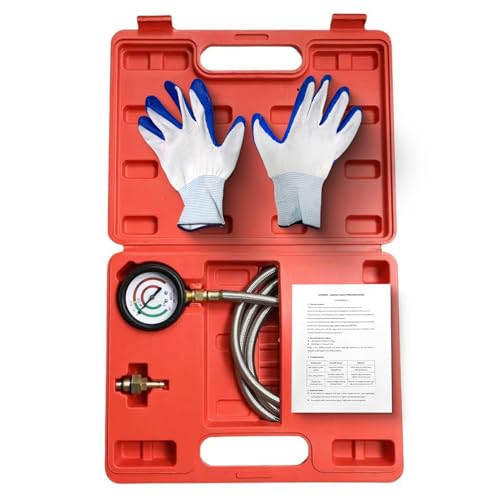
Best for driver-seated testing, APOWFIX uses a high-temperature stainless steel hose and provides M12/M18 adapters with a right-angle quick-connect. The gauge includes a shock-resistant housing and a rubber protective cover. It supports idle and 2500 RPM testing, quickly signaling blockages with a color-coded gauge.
Who it’s for: mobile diagnostic use and quick checks from the cab. Caution: ensure you have the correct exhaust port size to fit the adapters.
Autory Exhaust Back Pressure Tester Kit

Best for portable, durable field use, Autory’s kit features a quick-connect fitting for fast setup and a 6 ft hose for testing from the driver’s seat. The carry case helps protect components during transport. It diagnoses back pressure to determine whether the catalytic converter or muffler is blocked.
Who it’s for: technicians who work on multiple vehicles and need a compact, organized kit. Limitation: some users may prefer a larger gauge for easier reading in bright daylight.
MOTOCOCHE Exhaust Back Pressure Tester Kit

Best for clear, practical readings with dual-unit PSI/Bar display, MOTOCOCHE emphasizes rapid red-zone alerts to flag blockages. The 6-foot hose and robust construction support testing from the driver’s seat and in cramped engine bays. It helps prevent engine power loss caused by exhaust restrictions.
Who it’s for: shops and DIYers needing a straightforward, readable gauge. Caution: verify the connector compatibility with your vehicle’s oxygen sensor port before purchasing.
Buying Guide: Key Considerations For Selecting An Exhaust Back Pressure Gauge
- Hose length and seating position: Choose a kit with a long hose if you test from the driver’s seat or in tight spaces. Longer hoses improve reach but may add weight.
- Adapters and compatibility: Look for M12/M18 thread options to fit most exhaust ports. Ensure the kit includes adapters suitable for your vehicle’s sensor interfaces.
- Temperature tolerance: For diesel engines and turbo setups, a high-temperature hose (600°F/315°C) can prevent hose melting during prolonged tests.
- Readout clarity: Dual-unit gauges (PSI and Bar) with color bands help quickly interpret results. Red zones indicate potential blockages.
- Portability and storage: A carrying case protects components and simplifies on-site transport.
- Quick-connect vs. barbed fittings: Quick-connect fittings save time in tight spaces but ensure compatibility with your exhaust port type.
- Diagnostic scope: Some kits focus on catalytic converter issues, while others support turbo-related back pressure checks. Match the kit to your typical maintenance tasks.
Frequently Asked Questions
- What is considered normal back pressure at idle?
Typical idle back pressure is low; many kits specify 1.25 PSI or lower. Refer to the kit’s three-zone color bands for quick assessment.
- Can back pressure testing diagnose turbocharger problems?
Yes, abnormal back pressure can indicate issues with exhaust flow that affect turbo efficiency, but it’s one part of a broader diagnostic process.
- Do I need adapters for every vehicle?
Most kits include common M12 and M18 adapters; verify compatibility with your vehicle’s exhaust sensor interface before testing.
- Is a 6-foot hose necessary?
A longer hose lets you test from the driver’s seat, which is convenient for many vehicles, though it may not be essential for all users.
- What safety precautions are needed?
Operate with the engine running at idle or specified RPM, wear eye protection, and ensure the vehicle is in a safe, level area to avoid movement during testing.