When choosing an RV battery, your goal is dependable, long-lasting energy storage that fits your setup. This guide highlights five top options best suited for RVs, campers, and off-grid systems. Each product is evaluated for longevity, depth of discharge, temperature tolerance, and ease of use. The table below offers a quick snapshot to help you compare at a glance.
| Product | Best For | |
|---|---|---|
| SUPER EMPOWER 12V 100Ah LiFePO4 | Boondocking, small to mid-size RVs | Long cycle life, robust BMS |
| SUPER EMPOWER 12V 100Ah LiFePO4 (2 Pack) | Extended trips, larger layouts | Two-pack convenience, drop-in replacement |
| GoKwh 12V 320Ah LiFePO4 | Off-grid systems, solar-heavy RVs | High capacity, Bluetooth monitoring |
| Renogy Deep Cycle AGM 12V 200Ah | Maintenance-free, rugged use | Low self-discharge, safe chemistry |
| ECO-WORTHY 12V 280Ah LiFePO4 | Large RVs, heavy power users | Metal case, built-in protection |
12V 100Ah LiFePO4 By SUPER EMPOWER

The 12V 100Ah LiFePO4 battery from SUPER EMPOWER is designed for deep cycle energy storage in RVs, boats, and off-grid systems. Its integrated BMS protects against overcharge, over-discharge, overcurrent, short circuits, and temperature extremes. This unit is a true drop-in replacement for lead-acid, AGM, or SLA batteries, making it ideal for auxiliary house power in mobile setups. Best for RV users seeking long life with simple upgrades, especially when space is limited.
Best for: small to mid-size RVs that rely on consistent house power without engine starting duties. Why selected: strong cycle life, reliable protection, and straightforward installation.
Caution: Not suitable for engine cranking or starting applications. Consider a dedicated cranking battery if you need dual role power.
12V 100Ah LiFePO4 (2 Pack) Group 24 Battery

This 2-pack from SUPER EMPOWER provides a scalable energy solution for RVs with higher power demand or longer trips. It’s a drop-in replacement for lead-acid batteries using a BCI Group 24 size with M8 terminals. With a high cycle life and integrated BMS, these cells support stable daily performance while resisting temperature swings. Best for: RVers who want extra capacity without sacrificing compatibility. Why selected: two-pack convenience and identical fit to standard boxes.
Caution: Ensure your charging system supports lithium modes to avoid suboptimal charging performance.
GoKwh 12V 320Ah LiFePO4 Battery
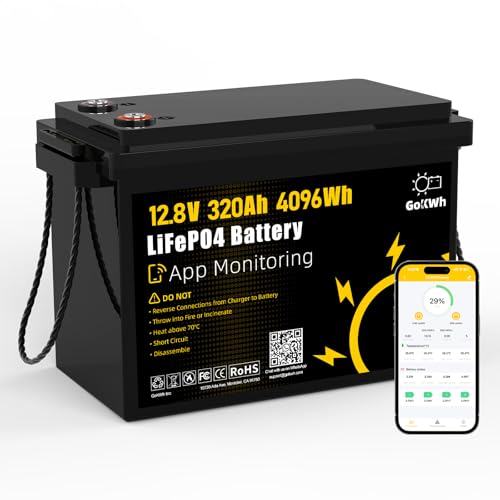
The GoKwh 320Ah LiFePO4 battery delivers 4096Wh of dependable power at 12.8V, making it a strong choice for larger RVs with higher energy needs. It features Bluetooth 5.0 monitoring to check voltage, current, and temperature remotely. It supports expansion to 4P4S for solar and off-grid systems, enabling scalable energy storage. Best for: campers who want real-time monitoring and room to scale. Why selected: Bluetooth monitoring and high capacity for longer stays off-grid.
Caution: Expansion requires compatible hardware and proper system design to maintain balanced charging across cells.
Renogy Deep Cycle AGM 12V 200Ah

Renogy’s 200Ah AGM battery provides maintenance-free operation with low self-discharge and high discharge currents. AGM technology reduces the risk of acid leaks and is ideal for RVs that need a robust, rugged power source with minimal upkeep. Best for: RVers who prefer maintenance-free functionality and strong initial current. Why selected: strong safety profile and reliable performance, widely trusted in RV and off-grid markets.
Caution: AGM chemistry has higher weight and may have shorter cycle life than some LiFePO4 options in very deep cycling scenarios.
ECO-WORTHY 12V 280Ah LiFePO4 Battery

The ECO-WORTHY 280Ah LiFePO4 battery features a robust metal enclosure for enhanced heat resistance and fire safety. It includes a built-in 200A BMS and mounting feet for direct installation inside an RV, saving space and simplifying setup. Best for: larger RVs or campers with heavy power usage that need a secure, high-capacity system. Why selected: metal case improves safety and provides straightforward installation.
Caution: Larger footprint may require more space; verify fitment and mounting before purchase.
Buying Guide: Key Considerations For RV Batteries
- Battery chemistry: LiFePO4 offers long cycle life and light weight compared to traditional AGM. Consider LiFePO4 for frequent cycling and deep discharge scenarios.
- Capacity needs: Assess daily energy use to estimate needed Ah. Higher Ah supports longer boondocking without recharging.
- Cycle life and DOD: Batteries rated for 5000–15000 cycles at various DoD levels deliver more value in RV settings. Higher DoD at moderate cycles can be cost-effective.
- Temperature tolerance: Low-temp protection is crucial for cold-season camping; ensure BMS handles cold charging.
- Battery management system (BMS): A robust BMS protects against overcharge, over-discharge, short circuits, and temperature extremes. Look for balanced cell monitoring and safety features.
- Installation and compatibility: Check dimensions, weight, terminal size, and whether the battery is a drop-in replacement for your current box. Some models fit standard Group 24 or Group 31 sizes.
- Monitoring options: Bluetooth or app-based monitoring helps track voltage, current, and temperature remotely, aiding maintenance and planning.
- Maintenance: AGM batteries are maintenance-free, while LiFePO4 requires no watering or venting. Consider your willingness to maintain or replace components as needed.
Frequently Asked Questions
- What is the best RV battery type for long trips? – LiFePO4 batteries generally offer longer cycle life, lighter weight, and better efficiency for deep cycling in RV setups.
- Can I mix battery chemistries in the same system? – It is not recommended. Mixing chemistries can create uneven charging and potential safety issues; use matched batteries in a system.
- Do I need a special charger for LiFePO4 in RVs? – Yes. Use a charger designed for lithium batteries or a lithium-mode setting on solar controllers to ensure proper voltage and protection.
- How do I know if a battery fits my RV? – Check the physical dimensions, weight, terminal type, and whether it matches your current battery box size (e.g., Group 24, Group 31).
- What is deep-cycle performance? – Deep-cycle performance describes how well a battery can deliver sustained energy over many cycles, which is crucial for RV off-grid use.
- Is maintenance required for AGM batteries? – AGM batteries are maintenance-free but can be heavier and have shorter cycle life than LiFePO4 options in some scenarios.