If you’re maintaining an RV, a smart battery tender is essential to keep your 12V system ready for travel and storage. The right charger not only tops off a battery but also prevents sulfation and extends life. This guide highlights five top picks tailored for RV use, from compact 750–1.25A units for motorcycles and small batteries to higher-capacity multi-bank chargers for full RV systems. Each option is explained with who it’s best for, why it’s chosen, and a practical limitation to consider.
Below is a quick comparison of the featured models to help you decide at a glance.
| Product | Best For | Main Benefit | Limitations |
|---|---|---|---|
| Battery Tender Plus 12V 1.25A | Single battery setups in RVs or to top off a bike or generator battery | Adaptive charge, 4-step program, reliable for daily maintenance | Not a multi-bank solution |
| NOCO GENIUS1 1A | Lead-acid and lithium systems in compact spaces | Thermal sensing, versatile chemistry support | Lower amperage for larger RV batteries |
| Battery Tender 3A Charger & Maintainer | Cars, SUVs, and smaller RVs needing a robust single-bank charger | Higher charging power with long cable reach | Not a multi-battery bank model |
| Battery Tender Junior 750mA | Small 12V powersports batteries or seasonal storage | Smart float charging, compact design | Lower amperage limits faster charging |
| NOCO GENIUS2D 2A | RV electrical setups with space for direct-mount installation | Direct mount, multi-chemistry support, desulfator | Direct-mount requires suitable mounting space |
Battery Tender Plus 12V 1.25 AMP Charger

The Battery Tender Plus is designed for a single 12V battery, including automotive, motorcycle, and lawn equipment batteries. It uses an adaptive smart charging program that automatically adjusts to battery needs, promoting longevity. It’s best for RV owners who need a dependable daily maintainer for one battery and want a straightforward setup. A 10-year warranty adds long-term confidence. A potential limitation is that it isn’t a multi-bank solution for RV electrical systems with several batteries.
NOCO GENIUS1: 1A 6V/12V Smart Charger

The GENIUS1 functions as a charger, maintainer, trickle charger, and desulfator for a range of 6V and 12V batteries, including lead-acid and LiFePO4. Its integrated thermal sensor adjusts charging with ambient temperature, helping prevent overcharging in hot weather. It’s ideal for RV owners with limited space or those who need a compact, all-in-one solution. The trade-off is its lower amperage for larger, high-capacity batteries.
Battery Tender 3 Amp Charger & Maintainer

This 3-amp model provides a stronger charge to automotive batteries before floating to maintain voltage. It’s well-suited for RVs with a larger starting battery or when you need quicker top-offs between trips. It includes a long reach cord and durable wiring. It’s best for RVs with a single battery bank where space allows for a compact installation. A limitation is that it does not handle multiple batteries in parallel without a separate unit.
Battery Tender Junior 750mA

The Battery Tender Junior focuses on small 12V batteries used in powersports and compact RV accessories. It offers a complete 4-step charging program and a float mode for long-term storage. It’s best for RV owners with smaller auxiliary batteries or seasonal setups. A limitation is its lower amperage, which extends time to full charge for larger batteries.
NOCO GENIUS2D: 2A Direct-Mount Charger
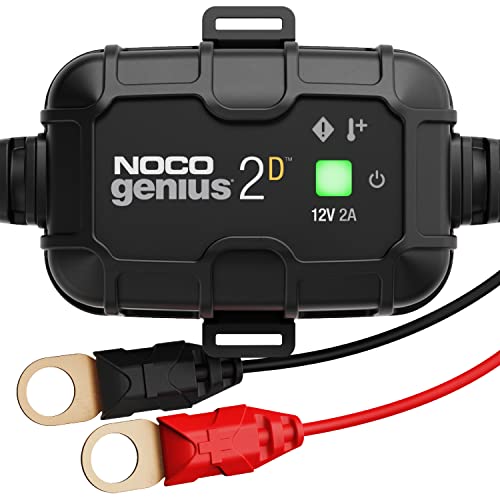
The GENIUS2D is a direct-mount onboard charger designed for 12V lead-acid batteries and Li-ion options. It provides a compact, hardwired solution with a built-in desulfator and temperature compensation. It’s best for RVs where space allows a secure, under-hood style installation and a neat, integrated setup. The need for mounting hardware and a suitable surface can be a limitation for some installations.
Buying Guide: What To Consider When Choosing a RV Battery Tender
How many batteries are in your RV system? If you only need to top off a single battery, a compact 1A–1.25A unit is often sufficient. For larger systems with multiple batteries, consider a multi-bank charger that can manage each battery independently without overloading the system.
What battery chemistries do you use? Most RV tenders support flooded lead-acid and AGM, with several models also handling LiFePO4. If you use lithium batteries, verify compatibility and charge profiles to prevent damage.
Do you need installability options? Direct-mount chargers offer a clean, space-saving setup ideal for permanent installations, while free-standing units work well in portable RV storage compartments.
What level of automation is desired? Chargers with multi-step charging programs and float maintenance help extend battery life with minimal supervision. For seasonal storage, float maintenance is particularly beneficial.
What about safety features? Look for spark-proof design, reverse polarity protection, short-circuit protection, and automatic shutoff to prevent overcharging and extend battery life.]
Frequently Asked Questions
- What is a battery tender and how is it different from a regular charger?
– A battery tender provides automatic maintenance after a full charge, including safe float charging and protections to prevent overcharging, which helps extend battery life in RVs. - Can I use these on lithium batteries?
– Some models support LiFePO4 and other lithium chemistries; check each product’s compatibility notes before use. - Is a multi-bank charger necessary for RVs?
– If your RV has several 12V batteries, a multi-bank charger can manage each battery independently, improving long-term health and readiness. - Do these chargers require professional installation?
– Direct-mount models may require basic mounting hardware and surface access; free-standing units are easier for portable use. - Will these chargers work while the RV is in storage?
– Yes, most tenders include float maintenance to keep batteries at optimal voltage during storage periods. - What amperage should I choose for a typical RV battery?
– For standard single-battery setups, 1–2A is common; larger or multiple-battery systems may benefit from 3–5A or multi-bank solutions.