When towing a trailer, choosing the right brake controller improves stopping power, trailer stability, and overall safety. The top picks here span wireless, proportional, and time-delay styles, suitable for 1- to 4-axle trailers and a range of vehicles. The best choice depends on how you tow, whether you want easy transfer between vehicles, or precise, adaptive braking under various loads.
This guide highlights five reliable options, noting who each product is best for, and why they were selected. A quick buyer’s table follows to help you compare at a glance.
Product Summary
| Product | Best For |
|---|---|
| CURT 51180 Echo Wireless Trailer Brake Controller | Casual to moderate towing; want wireless setup and smartphone control |
| LAJBZ Proportional Trailer Brake Controller (Primus IQ style) | Towers needing proportional, automatic braking with self-leveling |
| Gihdfer Proportional Trailer Brake Controller 8508211 | Hands-on installers who want LED display and real-time status |
| CURT 51116 Venturer Next Electric Trailer Brake Controller | Low-profile, dash-friendly installs for 1–3 axles |
| REDARC Tow-Pro Liberty Electric Trailer Brake Controller | Universal fit and easy install for 1–2 axles; versatile towing |
CURT 51180 Echo Wireless Trailer Brake Controller

The Echo is a portable wireless brake controller that plugs into a 7-way RV blade connector and links to a smartphone via Bluetooth. Best for owners who want zero-tools setup and easy transfer between vehicles. The OneControl app handles brake adjustment and profile storage, reducing the need to interact with the vehicle’s dash controls while stationary. Suitable for 1–2 axle trailers when paired with compatible connectors. A potential limitation is relying on a phone app for braking adjustments, which could be disrupted by battery or app issues.
LAJBZ Proportional Trailer Brake Controller
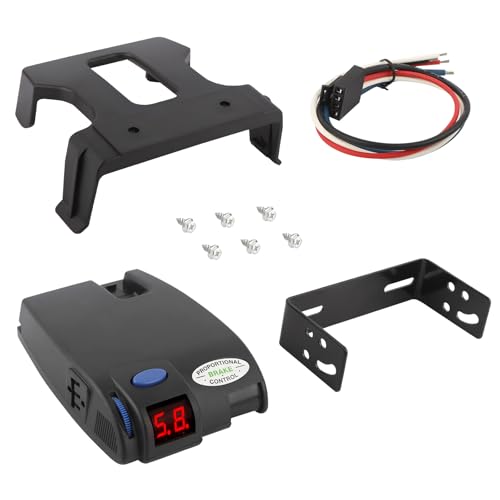
This unit provides proportional braking with self-leveling and a three-boost setting option. It’s ideal for 1–3 axle trailers and helps reduce trailer sway by automatically scaling brake pressure to the vehicle’s deceleration. Best for tow vehicles where consistent braking across different loads is important. The self-leveling feature simplifies setup, but installation should ensure proper calibration for accurate responses on varied mount angles.
Gihdfer Proportional Trailer Brake Controller 8508211

Gihdfer’s unit offers a proportional braking system with an LED display for real-time status. It supports 1–4 axles and promises smoother, safer braking by dynamically adjusting brake pressure as the vehicle slows. It’s best for buyers who want clear visibility of braking status and fine-tuning capability for heavier trailers. A consideration is the need to ensure vehicle compatibility and proper installation for accurate proportional control.
CURT 51116 Venturer Next Electric Trailer Brake Controller

The Venturer Next features a slim, low-profile design with a unique dash bracket system for better clearance. It’s fully adjustable for power and ramp time and supports 1–3 axles. It’s best for drivers who want a discreet, modern look on the dash without sacrificing control. The trade-off may be a steeper initial learning curve for proper ramp and power settings, especially on diverse towing conditions.
REDARC Tow-Pro Liberty Electric Trailer Brake Controller

The Tow-Pro Liberty provides proportional braking across 1–2 axles and is designed for universal fit with flexible wiring options. It’s a strong choice for owners seeking a robust setup that works across various vehicles, RVs, boats, or campers. A consideration is compatibility with specific vehicle wiring harnesses, which may require additional accessories for factory-style integration.
Buying Guide: Key Considerations For Selecting A Trailer Brake Controller
What towing load and axle range do you typically handle? Proportional controllers adapt braking to vehicle deceleration, offering smoother stops for heavier loads and minimizing trailer sway. Time-delay options can be simpler and effective for lighter setups but may feel less responsive under abrupt stops.
Do you prefer wireless or plug-and-play installation? Wireless models like the Echo offer portability and easy transfer between vehicles, but they depend on a stable smartphone connection. Plug-and-play and self-leveling designs reduce calibration effort and improve accuracy after installation.
Is dash space a concern? Low-profile controllers such as the Venturer Next are ideal for compact dashboards, but they may require more precise mounting and setup. Large displays or LED indicators, as with Gihdfer models, help monitoring in varied lighting conditions.
What axle range do you tow? Most units here support 1–3 axles, with some extending to 4. Confirm compatibility with your trailer’s axle count to avoid under- or over-braking.
Wiring and installation: Some controllers rely on universal wiring harnesses, while others integrate with specific vehicle systems. Evaluate whether you need a universal solution, vehicle-specific harnesses, or additional adapters for factory-style installation.
FAQ
What is a proportional trailer brake controller?
A proportional brake controller automatically adjusts trailer brake pressure to match the towing vehicle’s deceleration for smoother stops and reduced sway.
Is a wireless brake controller as effective as a wired one?
Wireless controllers offer portability and easy transfer but rely on Bluetooth or smartphone interfaces, which may require stable power and software access.
Can I use these controllers with 1–2 axle trailers?
Yes, many listed models support 1–2 axles; always verify the product specs for axle compatibility before purchase.
Do I need professional installation?
Some units are plug-and-play or self-leveling and easy to install, while others may benefit from professional wiring to ensure optimal performance.
What is self-leveling in brake controllers?
Self-leveling automatically adjusts the controller’s angle after mounting, ensuring consistent braking response without manual calibration.
Are there safety considerations when using a brake controller?
Ensure proper wiring, correct axle configuration, and that the controller’s ramp time and brake force match your load to prevent abrupt or ineffective braking.