Crucial for smooth starts and reliable acceleration, the right go-kart clutch makes a big difference in performance. This guide highlights five go-kart clutches that fit 3/4″ bore shafts and 12- or 10-tooth configurations commonly used with Predator 212, Honda GC/GX engines, and similar small engines. Best for backyard setups, beginner kits, or upgraded mini-karts, these options cover ranges from 10T to 12T and #35 to #40/41/420 chains. Each entry includes intended use, compatibility, and a practical caution to help you choose with confidence.
Summary table of chosen products:
| Product | Brand | Best For | Key Chain Size | Bore |
|---|---|---|---|---|
| GYMMEDS Go Kart Clutch (12T, 3/4″ Bore) | GYMMEDS | Go karts and minibikes needing 12T clutch | #35 | 3/4″ |
| Bravex Centrifugal Clutch (10T, 3/4″ Bore) | Bravex | Mini bikes and fun karts with longer life | #40/41/420 | 3/4″ |
| Go Kart Clutch for 2-6.5HP Engines (12T, 3/4″ Bore) | TadaMark | Predator 212/Honda clones and similar engines | #35 | 3/4″ |
| GYMMEDS Go Kart Clutch (10T, 3/4″ Bore) | GYMMEDS | Single-wheel drive karts and mini bikes | #40/41/420 | 3/4″ |
| VASHLY Go Kart Clutch (12T, 3/4″ Bore) | Vashly | Go karts, minibikes, and fun karts | #35 | 3/4″ |
GYMMEDS Go Kart Clutch 12T (3/4″ Bore) with #35 Chain

The 12-tooth centrifugal clutch is designed for 3/4″ bore shafts and fits a variety of small engines including Predator 212cc, Honda GC/GX family, and other 3/4″ shaft engines. The included chain length supports #35 chain setups, with a fixed pitch commonly used by many mini bike and go-kart configurations. Best for builders seeking a robust, versatile option for 2-6.5 HP engines. A caution: verify keyway width and shaft dimensions before purchase to ensure compatibility with your specific engine model.
Why it’s chosen
Best for players who want a balance of compatibility and torque capacity. The 12T size offers solid engagement with reliable power transfer, especially in small-to-mid sized go-kart builds using Predator 212 or Honda clones. The steel construction provides wear resistance for routine backyard sessions.
Bravex Centrifugal Clutch (10T, 3/4″ Bore)
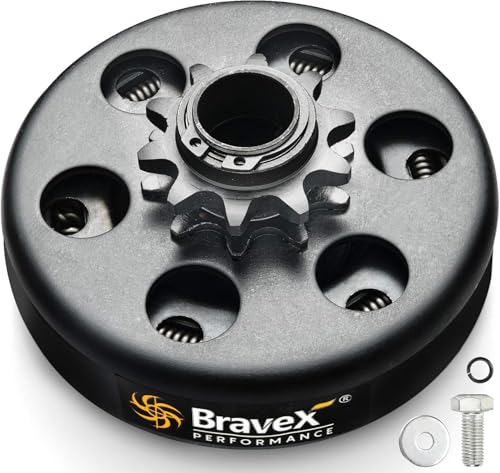
This clutch uses a 10-tooth configuration with a 3/4″ bore and is designed for #40/41/420 chain. Built from high-impact steel, it promises longer life in demanding go-kart and mini bike setups. It’s suitable for 6.5 HP class engines and various clones. Best for riders seeking a lighter engagement with extended wear resistance. Limitation: the 10T model may require a larger chain or different gearing to optimize torque for specific tracks or climbing conditions.
Why it’s chosen
Choose this if you want a longer service life and a slightly higher engagement threshold. It’s particularly well-suited for fun-kart builds and district-level mini bike racing where chain compatibility and durability matter more than the absolute maximum torque.
Go Kart Clutch for 2-6.5HP Engines (12T, 3/4″ Bore)

This 12-tooth centrifugal clutch supports 3/4″ bore and #35 chain, with an engagement speed around 2300 RPM. It lists compatibility with several Honda-based engines (GC160/GC190/GX120/GX140/GX160/GX200) and Tecumseh or Briggs & Stratton variants in the 2-6.5 HP range. Best for standard 4-foot drive setups using #35 chain. A limitation: the note clarifies it does not fit 0.787″ (20mm) bores, so confirm shaft size before ordering.
Why it’s chosen
Best for builders who want a straightforward bolt-on option with clear engine compatibility. This clutch aligns well with common small-engine combos used in backyard go-karts and minibikes, while including a chain and hardware for quick assembly.
GYMMEDS Go Kart Clutch 10T (3/4″ Bore) with #40/41/420 Chain

This 10-tooth clutch is sized for 3/4″ bore and supports wider chain pitches (#40/41/420). It’s designed for 2-6.5 HP engines, making it a solid upgrade for Predator 212 setups and Honda clones. It’s ideal for single-wheel drive karts with modest tire height. A word of caution: ensure your engine setup and chain pitch match the clutch to avoid misalignment or premature wear.
VASHLY Go Kart Clutch 12T (3/4″ Bore) for #35 Chain

Designed for 12-tooth clutch with a 3/4″ bore and 35-chain compatibility, this model targets Predator 212, Honda GX160/GX200, and similar engines. It fits 2-6.5 HP range engines with a 3/4″ shaft. Best for drivers who want a reliable, balanced engagement in standard kart builds. Limitation: chain length and alignment must be verified, as “chain not included” in some listings.
Buying Guide: Key Considerations for Go-Kart Clutches
- Engine compatibility: Confirm bore size (3/4″) and chain pitch (#35 vs #40/41/420). Different engines use specific clutches to ensure proper engagement.
- Tooth count and engagement: 10T clutches typically engage earlier and lighter; 12T clutches offer more torque transfer and might be better for heavier karts or steeper grades.
- Chain compatibility: Some clutches include chain; others require you to source separately. Match the chain pitch to your drivetrain (9.525 mm vs 9.525 mm equivalent for #35 chain).
- Material durability: High-impact steel provides wear resistance and heat dissipation, which helps under repeated starts and off-road use.
- Installation notes: Check keyway size and shaft diameter on your engine. Some clutches require exactly 3/4″ shafts and 3/16″ keyways; others may vary slightly.
- Heat and performance: Heavy-duty clutches reduce slipping and overheating on longer sessions. Consider this for frequent racing or backyard endurance runs.
- Maintenance: Inspect set screws and connectors; replace worn components promptly to prevent drive failure.
FAQ
- What bore size do most go-kart clutches use?
Most common clutches use a 3/4″ bore with 3/16″ keyways, designed for 2-6.5 HP engines like Predator 212 and Honda clones. - Should I choose a 10T or 12T clutch?
10T clutches engage earlier and are better for lighter karts; 12T clutches provide stronger torque transfer for heavier builds or steeper terrain. - Do these clutches include chains?
Some listings include chains (often #35 or #40/41/420). If not included, verify chain compatibility and purchase accordingly. - Are these clutches suitable for all mini-kart engines?
They are designed for engines in the 2-6.5 HP range with 3/4″ shafts; verify your engine model and shaft specs before ordering. - Can I reuse a clutch from a different kit?
Clutches must match bore, chain pitch, and shaft dimensions; mixing incompatible components can cause misalignment and wear. - What is the main risk of a mismatched clutch?
Wrong bore or chain pitch can lead to slippage, overheating, and accelerated wear, reducing performance and safety.