The top picks below are versatile OBD II code readers designed for most cars built since 1996. They help you read and clear engine codes, view live data, and check readiness for smog tests. This guide highlights five strong options, explains who each device is best for, and notes any limitations.
Buyer profiles:
– DIYers who want simple, fast code reading and clear fault codes.
– Car owners who need live data and basic diagnostics without a high price tag.
– Weekend mechanics who need broader system access (engine, emissions) without professional tools.
– Users seeking portable, battery-free operation powered directly from the vehicle.
| Product | Best For | Key Benefit |
|---|---|---|
| ANCEL AD310 | Budget-friendly diagnostics for most 1996+ vehicles | Fast, clear engine code read/clear; solid build |
| MOTOPOWER MP69033 | Wide compatibility with multiple protocols | Large display; multilingual; versatile |
| FOXWELL NT301 | Live data and easy code reading | Clear live data and VIN read |
| VDIAGTOOL VD10 | DIYers who want to see DTC definitions locally | Large built-in DTC database |
| ZMOON ZM201 | Engine-focused diagnostics with freeze-frame data | Live data, I/M readiness, EVAP tests |
ANCEL AD310 Classic Enhanced OBD II Scanner

Named for its popular status and Scotty Kilmer endorsement, the AD310 reads and clears emission-related codes, shows live data, freeze frame, I/M readiness, and general vehicle information. It draws power directly from the OBD II port and requires no battery or charger. Best for budget-conscious buyers who want straightforward fault reading and a compact tool for light-to-moderate diagnostic tasks.
Best for: DIYers and casual drivers who need a compact, reliable code reader for typical engine fault checks. Limitations: It does not offer advanced ABS/SRS/maintenance features beyond basic engine diagnostics.
What’s included in the AD310 features
- Clear read/clear fault codes from emission systems
- Read live data and memory data
- View freeze frame, I/M readiness
- Direct power from OBD II port; no batteries required
MOTOPOWER MP69033 Car OBD2 Scanner

The MP69033 supports 9 protocols across most 1996 US-based, 2000 EU-based, and Asian cars, plus newer OBD II vehicles. It offers a built-in DTC library, live data curves, fuel/engine metrics (speed, load, coolant temperature, RPM), and a 2.8″ LCD with backlight. It’s powered via the OBDII port, removing the need for separate power sources. Best for: buyers who want wide protocol coverage and a clear display for everyday diagnostics, including live data visualization.
Best for: users needing broad vehicle compatibility and multilingual support. Limitation: It does not replace a professional diagnostic tool for complex systems beyond engine management.
Key advantages
- Wide protocol support for many regions
- Large LCD with backlight for readability
- Built-in DTC lookup and basic live data
FOXWELL NT301 OBD2 Scanner

The NT301 specializes in reading fault codes, live data, and VIN information. It supports emission readiness checks and can turn off the CEL (MIL) after repairs are complete. It’s compatible with most 1996+ gasoline cars and some 12V diesels, but it does not support ABS, SRS, or some advanced functions. Best for: improvised DIYers who want a straightforward tool that handles common engine diagnostics and live data logging without extra features.
Caution: The device may require correct menu navigation and proper vehicle wiring to obtain accurate results. It’s a foundational tool, not a full system scanner.
What to expect
- Read and clear engine codes
- View live data and basic sensor readings
- VIN retrieval and MIL reset after repair
VDIAGTOOL VD10 OBD2 Scanner
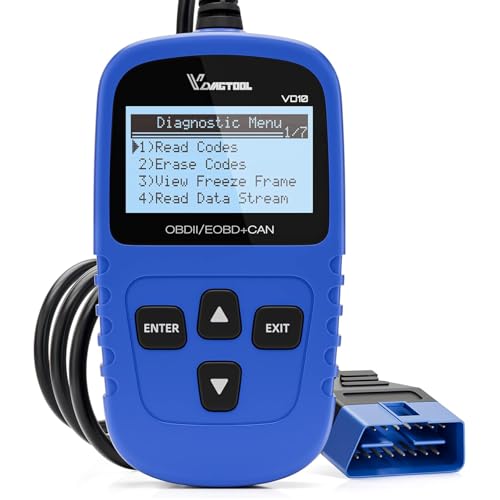
The VD10 is pitched as a must-have for DIYers, with easy attachment to the OBD II port and quick diagnostics. It reads/clears codes, shows live data, freeze frame, I/M readiness, and vehicle information. It uses a built-in database with more than 3,000 codes, helping users identify root causes quickly without external lookups. Best for: homeowners who want a fast, self-contained code reader with useful definitions on-device.
Note: It focuses on engine diagnostics and does not claim multi-system deep-dive capabilities like ABS or SRS. Limitation: not all advanced modules are supported on every vehicle.
Why this matters
- Directly shows code definitions on the screen
- Simple, intuitive interface for quick checks
- Affordable option with extensive DTC database
ZMOON ZM201 Professional OBD2 Scanner

The ZM201 is designed to work with all vehicles after 1996 and can read/clear engine fault codes, display live data with freeze frame, and perform EVAP checks. It’s powered directly via the OBD II port, avoiding separate power needs. Best for: engine-focused diagnostics where the user wants clear data presentation and an extensive DTC database to estimate root causes. Limitation: it does not support ABS, SRS, or other non-engine systems, so use it primarily for engine-related issues.
Key strengths: fast code retrieval, robust DTC library, and live data streaming for engine performance monitoring.
ANCEL AD410 Enhanced OBD2 Scanner

The AD410 offers wide compatibility across OBDII vehicles and provides rapid fault code reading/clearing, I/M readiness, and advanced diagnostics such as O2 sensor testing and EVAP monitoring. It includes more than 42,000 built-in DTC lookups and supports multiple languages. Best for: users who want a more capable engine tool with additional diagnostics like EVAP and O2 testing, suitable for international users and vehicles with diverse markets. Limitation: the AD410 is an engine-focused tool and does not provide full ABS or transmission system diagnostics.
Selected advantages
- Extensive DTC library
- EVAP and O2 sensor tests for engine optimization
- MIL reset and monitor readiness checks
Buying Guide: Key Considerations For Choosing A Car Code Reader
What does “OBD II” compatibility mean for you?
OBD II compatibility ensures you can read standard diagnostic trouble codes on most US, EU, and Asian vehicles manufactured after 1996. Choose a model that explicitly supports OBD II and CAN for broad vehicle coverage.
What levels of diagnostics do you need?
Engine-only readers are lighter and cheaper. If you want live data, I/M readiness, and freeze-frame data, pick a model with display-enabled data streams and a robust DTC library. For multi-system checks (ABS, SRS, transmission), look for 5-in-1 tools with broader system access.
Power and portability considerations
Most plug directly into the OBD II port and draw power from the car. If you prefer handheld use, ensure the device is compact and well-built. Battery-free operation is common and convenient for quick checks.
Display quality and data presentation
A clear LCD or OLED display with backlight improves readability in different lighting conditions. A readable interface helps interpret fault codes and live data quickly.
Language and regional support
Some scanners offer multilingual menus and DTC definitions. If you travel or work with vehicles across borders, multilingual options reduce ambiguity in fault interpretation.
Frequently Asked Questions
- Do all OBD readers work on every car? No. Most readers work on 1996+ US-based vehicles and many imports, but always verify compatibility with your vehicle’s year, make, and model.
- Can I reset the check engine light with these tools? Generally, you can clear codes after修 repairs, but the MIL often reappears if the underlying issue remains unresolved. Some scanners can turn off MIL temporarily during testing.
- Do these devices require an internet connection? Most do not require a connection; they rely on built-in code databases. Some advanced models may offer online repair databases or updates via USB or Bluetooth.
- Is Bluetooth necessary for car scanners? Bluetooth is optional. It enables smartphone-based apps for more features, but many basic devices operate as standalone handheld units.
- Should I buy a high-end scanner or a budget option? If you only need engine fault codes and basic diagnostics, a budget or mid-range model is sufficient. For broader system access and professional-grade features, consider a higher-end model.
- Do these tools require installation or software updates? Most come ready to use out of the box and may offer periodic firmware updates via manufacturer apps or updates to expand DTC libraries.