If you need to read and clear check engine codes quickly, these OBD2 scanners are the right tools. They’re designed for DIYers, first-time users, and budget-conscious drivers who want fast fault code readings and practical explanations. The top picks below are best for different needs: rapid fault code retrieval, live data viewing, battery testing, and pre-purchase checks. See the quick product table to compare core features at a glance.
| Product | Best For | Key Benefit |
|---|---|---|
| ANCEL AD410 | All OBDII cars, quick fault code read/clear | Extensive DTC database and EVAP testing |
| FOXWELL NT301 | Live data and MIL control | Good balance of live data and simple use |
| Yakry 1S | Battery testing with engine codes | Integrated battery health insights |
| HipEpic OBD2 | All-round code reading, readings and tests | Battery test and broad data |
| AUTOPHIX OM126P | Plug-and-play, emmisions readiness | Clear I/M readiness and universal fit |
Note: Each tool lists compatible vehicle scopes, but always verify your vehicle’s year, make, and model before purchase. This article presents objective, feature-based guidance to help you choose what’s best for your situation.
ANCEL AD410 Enhanced OBD2 Scanner

The AD410 is designed for broad OBDII compatibility with 16-pin vehicles and supports common protocols like KWP2000, ISO9141, J1850, and CAN. It powers directly from the vehicle and does not require a separate battery. This makes it a strong option for drivers who want a straightforward, battery-free reading experience. It quickly reads and clears fault codes, with access to over 42,000 built-in DTC lookups for quick fault identification. It also offers enhanced diagnostics including O2 sensor and EVAP testing, which helps refine fuel efficiency insights. A limitation to note: it is an engine-code reader and does not support ABS, SRS, or transmission diagnostics. Best for: drivers who want a no-fruss and fast engine-focused scan for standard cars and light trucks.
FOXWELL NT301 OBD2 Scanner

The NT301 focuses on fault code reading with live data capabilities and readiness status checks. It can retrieve DTCs, monitor emissions statuses, and can turn off the check engine light after repairs are complete. It provides real-time data graphs for common sensors and is compatible with most 1996+ gasoline cars and many 2000+ European and Asian models. This tool is best for users who want clear live data and a reliable rollback of the MIL once repairs are completed. Caution: it does not support ABS, SRS, EPB, or advanced calibration functions. Best for: DIYers who want straightforward code reading plus live data for quick troubleshooting.
2-in-1 OBD2 Scanner With Battery Tester – Yakry
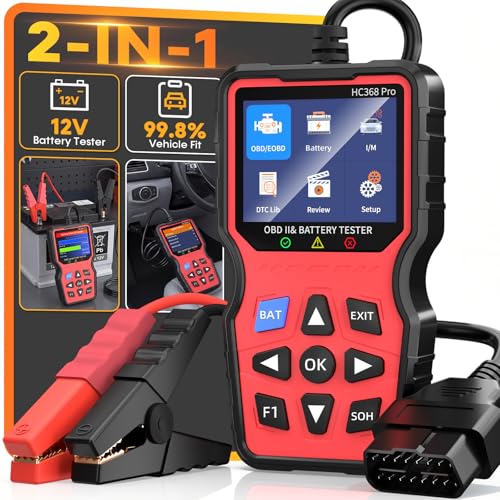
This Yakry device combines a fast engine code read/clear with a built-in 12V battery health test. In under 3 minutes, you can confirm engine fault codes and evaluate battery health indicators such as CCA and SOH. It includes a large backlit display and icon-guided results, making it accessible for first-time users. Best for: pre-road-trip safety checks and simple on-the-spot diagnostics where both engine codes and battery health matter. Caution: its battery test mode may be less feature-rich than standalone battery testers on the market.
AUTOPHIX OM126P OBD2 Scanner

The OM126P emphasizes broad vehicle coverage for U.S., European, and Asian models, with user-friendly plug-and-play setup. It supports I/M readiness checks to help you verify smog compliance before inspections. The device reads and clears fault codes and displays live data. A notable limitation is that it may not support advanced functions beyond standard code reading and basic live data in some car models. Best for: motorists who want a reliable all-round scanner with quick I/M readiness checks for regular vehicle maintenance.
Buying Guide
What should you look for in an OBD2 scanner?
- Vehicle compatibility: Ensure the scanner supports your car’s year, make, and model and note any noted exceptions (ABS, SRS, transmission if listed as unsupported).
- Read/clear capability: Look for devices that can read DTCs, clear codes, and provide code definitions without needing external references.
- Live data and graphs: If you want to monitor sensor behavior, choose scanners with real-time data streams and graphing.
- Additional tests: Battery testing, EVAP, and O2 sensor tests add value for proactive maintenance.
- Ease of use: A clear display, intuitive menus, and a straightforward one-click I/M readiness feature help beginners.
- Data sharing: Some models offer cloud or local printing to share diagnostic reports with technicians or for records.
Which features matter most by use case?
- DIY daily driver: A model with 1-click I/M readiness, clear code definitions, and battery testing is convenient.
- Pre-purchase inspection: A scanner with VIN retrieval, freeze-frame data, and broad DTC coverage helps assess hidden issues.
- On-the-road troubleshooting: Real-time live data and O2/EVAP tests allow quick insight into running conditions.
- Professional review: Look for expansive DTC databases, dual printing capabilities, and emissions testing support when available.
How to interpret results effectively?
- Note the exact DTC code and its meaning from the built-in code lookup.
- Check the readiness monitors (I/M Readiness) to determine if the vehicle can pass a smog inspection.
- Review live data trends to spot intermittent faults and understand whether readings are within expected ranges.
- Address underlying issues rather than just clearing codes to avoid recurring MIL warnings.
FAQs
- Do these scanners require a battery?
- Can I clear codes without repairing the car?
- Will these work on all cars after 1996?
- Is live data necessary for diagnosing problems?
- What is I/M readiness?
- Can these tools diagnose ABS or transmission problems?
Most plug directly into the OBDII port and draw power from the vehicle; batteries are not required for operation.
Some scanners allow code clearing after repairs are completed; clearing before fixes may cause codes to return.
Most listed devices support OBDII vehicles from 1996 onward, but verify compatibility with your specific make and model.
Live data helps identify intermittent issues and track sensor performance, but basic code reading can be sufficient for simple repairs.
I/M readiness indicates whether the vehicle’s emission monitors are ready for inspection, helping determine smog pass likelihood.
Most consumer OBD2 scanners focus on engine diagnostics; many do not support ABS, SRS, or transmission fault codes.