If you need a reliable diagnostic device for cars to pinpoint engine problems quickly, an OBD2 scanner is your best tool. This guide highlights five well-rounded options, from easy-to-use tools for beginners to advanced multifunction scanners for seasoned DIYers. Each pick is suited to different buyers—from casual tinkerers to professional service enthusiasts—and helps you read, interpret, and clear codes to get your vehicle back on the road.
Summary table of chosen products:
- ANCEL AD310 Classic Enhanced Universal OBD II Scanner
- VDIAGTOOL VD10 OBD2 Scanner
- MOTOPOWER MP69033 OBD2 Scanner
- UMEIJA V011 OBD2 Bluetooth Scanner
- ZMOON ZM201 Professional OBD2 Scanner
ANCEL AD310 Classic Enhanced Universal OBD II Scanner

Best for: Home mechanics and casual hobbyists who want a straightforward tool to read and clear engine codes quickly. The AD310 is compact, with a sturdy 2.5-foot cable and a large-screen display that makes results easy to read in tight engine bays. Its ability to read live data, view freeze frame, I/M readiness, and vehicle information supports quick symptom verification and repairs.
Why it’s selected: This model is among top sellers and is noted for fast, accurate results and straightforward operation. It powers directly via the vehicle’s OBDII port, removing the need for separate batteries or chargers, which simplifies on-the-spot diagnostics.
Caution or limitation: While well-suited for general emission-related codes, it may not support every advanced parameter on every vehicle, so confirm compatibility for specialized systems before relying on it for complex diagnoses.
VDIAGTOOL VD10 OBD2 Scanner
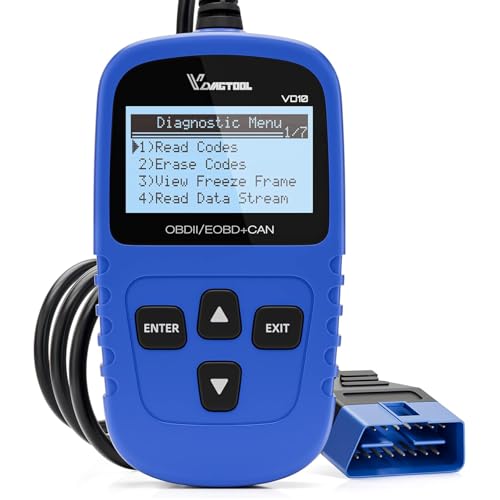
Best for: DIY enthusiasts who want a robust read/clear capability with a built-in data library and a clear, user-friendly display. The VD10 provides code reading, erasing, freeze frame, I/M readiness, and a permanent code dictionary on its TFT screen, making it a practical all-around tool for regular car maintenance.
Why it’s selected: It offers broad code coverage (P and U family codes, etc.) with a built-in database of more than 3,000 codes, simplifying troubleshooting without the need to search online. It’s especially helpful when you want on-device definitions to speed up repairs.
Caution or limitation: It relies on on-screen definitions, which are helpful, but complex vehicle specifics may still require cross-referencing with a professional database or dealer diagnostics for rare codes.
MOTOPOWER MP69033 Car OBD2 Scanner

Best for: Drivers seeking a wide protocol reach for vehicles from 1996 onward, with a simple LCD interface. The MP69033 supports 9 protocols and provides common engine data such as speed, coolant temperature, and engine load, along with live data and freeze frame capabilities.
Why it’s selected: Its broad compatibility and clear display make it a reliable choice for owners of mixed-car fleets or those who work on multiple vehicle types. The device gets power directly from the car, which simplifies setup.
Caution or limitation: The tool focuses on engine diagnostics and basic vehicle data; it does not explicitly cover advanced ABS/SRS diagnostics beyond standard engine codes.
UMEIJA V011 OBD2 Scanner
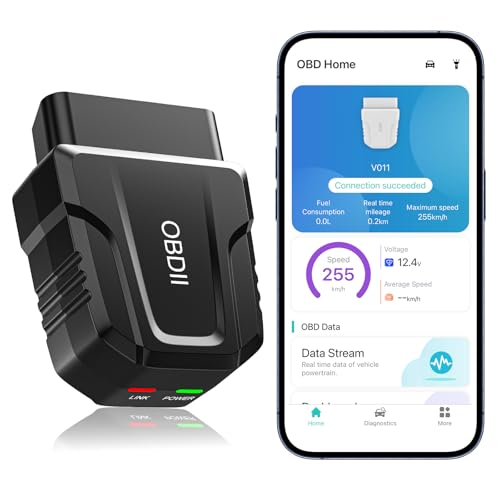
Best for: Android and iOS users who want wireless, real-time diagnostics and performance testing via a dedicated mobile app. The V011 supports 9 protocols, live data streaming, VIN retrieval, and repair-oriented guidance for clearing CELs with confidence.
Why it’s selected: The Bluetooth-enabled design provides convenient remote diagnostics, and its intuitive app aids interpretation of DTCs, emission readiness, and data visualization—helpful for those who value ongoing monitoring and historical data in an app environment.
Caution or limitation: Clearing fault codes typically requires that issues be addressed first; the tool’s guidance hinges on completing repairs to reset indicators, which might frustrate those seeking code clearance without fixes.
ZMOON ZM201 Professional OBD2 Scanner

Best for: Users who want a purpose-built engine diagnostic tool with a large, built-in code database and live data features. The ZM201 emphasizes engine diagnostics for vehicles after 1996 and provides live data, freeze frame, optional EVAP checks, and I/M readiness to help ensure a smooth emissions test.
Why it’s selected: It focuses on engine diagnostics with a clear emphasis on essential services like read/clear codes and live data, while avoiding unnecessary features that add cost or complexity for engine-focused troubleshooting.
Caution or limitation: It does not support ABS, SRS, transmission, or other advanced vehicle systems beyond engine diagnostics, so users needing broader vehicle health checks may want a multi-system model.
Buying Guide: How To Choose An OBD2 Diagnostic Tool
What will you diagnose most often?
Begin with your primary use case. If you mainly want quick trouble code reads and emissions readiness, a simpler model like the AD310 or MP69033 may suffice. If you routinely troubleshoot multiple systems or pursue advanced checks, consider a 5-in-1 tool like the FOXWELL NT604 Elite, which includes ABS and SRS diagnostics.
Compatibility and protocol coverage
Ensure the scanner supports all OBDII protocols needed for your vehicles (KWP2000, ISO9141, J1850 VPW/PWM, CAN, etc.). Vehicles from different regions may require broader protocol support, especially if you work with imports or older models.
Display, data, and interface
Look for a clear display (LCD or TFT), intuitive navigation, and the ability to read live data and freeze frames. If you prefer wireless use, Bluetooth-enabled models paired with a mobile app can provide richer charts, VIN lookup, and historical data.
Data independence and code definitions
Some scanners rely on built-in code libraries with definitions for thousands of DTCs. This reduces the need to search online, saving time when diagnosing symptoms or explaining issues to others.
Ease of use and power source
Out-of-the-box usability matters for quick diagnostics. Most OBD2 scanners draw power from the vehicle; others may require batteries. Consider whether you need a compact form factor for storage in a glove box.
Limitations and expectations
Remember that a diagnostic tool identifies faults and provides data, but it does not perform repairs. Some cars may require professional tools or dealer-level diagnostics for certain systems, especially ABS, SRS, or transmission.
FAQ
- Do I need an OBD2 scanner for a CAR with a check engine light?
Yes. An OBD2 scanner reads diagnostic trouble codes, shows live data, and helps identify root causes. It enables you to clear codes after repairs are made. - Can I use a Bluetooth OBD2 scanner with my phone?
Yes. Bluetooth scanners pair with compatible iOS or Android apps to display live data, error codes, and diagnostic insights on your phone. - Will these scanners fix my car’s problems?
No. They read codes and present data. Repairs must be performed by a qualified technician or the vehicle owner, and codes can be cleared once the issues are resolved. - Are all OBD2 scanners universal for all cars?
Most 1996-and-newer vehicles in the US, EU, and many other regions use OBD2. Some models or regions may have unique systems; check compatibility before purchasing for precise needs. - Is live data enough to diagnose complex issues?
Live data helps identify symptoms and monitor performance, but complex problems may require additional tests and professional diagnostics.