Answering shoppers who want a clear, at-a-glance readout of vehicle data, this guide highlights top digital gauges for cars. These devices help drivers monitor speed, RPM, water temperature, voltage, and more without taking their eyes off the road. Ideal for enthusiasts, long-haul drivers, and safety-conscious commuters, the picks below balance readability, install options, and data richness. The table below compares five strong choices by data modes, compatibility, and display style.
| Product | Mode | Best For | |
|---|---|---|---|
| wiiyii OBD2 Gauge Display Heads Up Display (P6) | OBD2 + GPS | Daily drivers who want a simple glance at speed, RPM, water temp | Flexible mounting; multiple interfaces |
| MH Head Up Display for Car | OBD2 + GPS | Vehicles built after 2008 needing fault codes alongside data | Fault diagnosis and dual-system switch |
| WATERWICH 52mm Voltmeter | Dedicated volt gauge | Electrical system monitoring; nighttime visibility | Blue backlight; simple installation |
| MAIMEIMI OBD2 + GPS Dual System Gauge | OBD2 + GPS | Users wanting rich data UI and multiple modes | 10 modes; customizable UI |
| AZIJYV OBD2 Gauge Display (P6 Style) | OBD2 + GPS | Those needing a dual-mode HUD with wide data options | Multiple data displays; cautions for older cars |
The following sections detail five top products. Each entry explains who should buy, why it was selected, and any practical caveats to consider before purchasing.
wiiyii OBD2 Gauge Display Heads Up Display
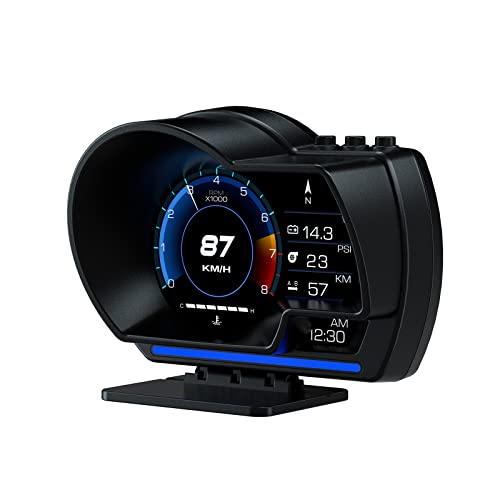
The wiiyii P6 HUD provides speed, RPM, water temperature, and overspeed alarms via an OBD2 and GPS dual system. It offers 10 interfaces and adjustable brackets for dashboard or windshield mounting. Best for drivers who want a simple, glanceable display with minimal distraction. Caution: some vehicles may require switching to GPS mode if OBD data is limited by the ECU. This unit emphasizes straightforward driving data without deep fault-code management for casual users.
MH Head Up Display for Car, OBD2+GPS Dual System

The MH HUD supports real-time driving data with dual OBD2 and GPS modes. It’s well-suited for drivers who want fault code scanning and the ability to monitor multiple data streams, such as speed, RPM, water temperature, and voltage. Best for cars manufactured after 2008 seeking deeper data insights. Better for users who value diagnostic capabilities; best not used on older diesel or highly modified vehicles where compatibility is limited.
WATERWICH DC12V Voltmeter Blue Digital LED Volt Gauge

This voltmeter focuses on electrical system health, displaying 8–18V with a blue backlit display for night visibility. It’s best for drivers who want a dedicated voltage reading and clear nighttime readability. Choose this if your primary goal is battery and alternator monitoring rather than a full engine data HUD. Limitation: it provides voltage data more than vehicle speed or engine analytics, so it’s not a complete HUD solution.
MAIMEIMI OBD2 Speedometer with GPS Dual System

The MAIMEIMI device offers both OBD2 and GPS data, with ten data display modes and multiple UI interfaces. It can show speed, water temperature, oil temperature, voltage, RPM, and more, with GPS mode adding altitude and distance tracking. Best for users who want flexible data presentation and multiple color themes. Choose this if you value UI customization; avoid this if your car’s OBD2 is not fully compatible and you rely solely on GPS data.
AZIJYV OBD2 Gauge Display, HUD for Cars
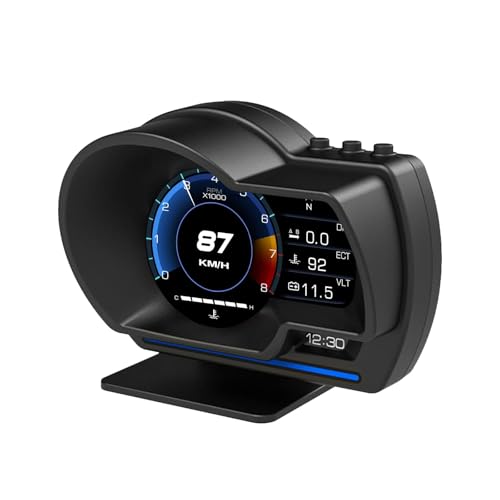
AZIJYV’s P6-style HUD is a dual-mode system that supports OBD2 and GPS. It features a broad data range, including speed, water temperature, voltage, altitude, and more, with multiple UI options. Best for drivers who want a feature-rich HUD in a single device. If your car is older or diesel, rely on GPS mode as the OBD data may be limited or not supported.
Buying Guide
What data should a car HUD display include?
Essential data typically includes current speed, RPM, water temperature, voltage, and fuel consumption. For safety and maintenance reasons, fault codes and drive time can be valuable. Users who frequently tow, haul, or drive in varying terrains may prefer altitude, turbo pressure, or oil temperature data if the device supports it.
Which mode is best for my vehicle?
OBD2 mode works with most gasoline cars built after 2008, providing live data from the ECU. GPS mode is universal but provides data independent of vehicle diagnostics. Dual-mode units offer flexibility and broader data sets, but always verify compatibility with your car’s year, make, and model before buying.
How easy is installation?
Most units offer dashboard or windshield mounting, USB or OBD cables, and simple setup via an LCD interface. Non-destructive installation is a plus for rental cars or short-term use. If your vehicle has limited OBD2 access, GPS mode may be the default and sufficient for speed and distance reading.
What about glare, night readability, and driver distraction?
Look for devices with adjustable brightness, clear numeric displays, and 1.7–2.5 inch display sizes to minimize distraction. A HUD that reflects data at a glance helps reduce eyes-off-road time, improving safety during night driving and high-speed conditions.
Power, compatibility, and limitations
Most HUDs draw power from the vehicle’s OBD2 port or 12V supply. Check voltage ranges (commonly 9–39V) and confirm vehicle compatibility, especially for diesel, hybrids, or modified cars. Some devices may not support all data fields in every car’s ECU, so plan for mode switching as needed.
Quick comparison by scenario
- Best for simple, quick speed readouts: wiiyii HUD.
- Best for fault codes and deeper data in newer cars: MH HUD.
- Best single-function voltage monitoring: WATERWICH voltmeter.
- Best UI customization and data breadth: MAIMEIMI dual-system gauge.
- Best all-around HUD with dual modes and rich displays: AZIJYV P6-style gauge.
FAQ
- Do these HUDs work on all cars? Most work with OBD2-equipped vehicles manufactured after 2008. GPS-only modes work with all vehicles, but data depth varies.
- Will installing affect my warranty? Generally, these devices are non-invasive, but check your vehicle’s warranty terms and dealer guidance for any concerns about dashboard-mounted devices.
- Can I install these myself? Yes, most installations require basic mounting and cable routing. Follow manufacturer instructions for safe placement and software setup.
- Which is best for safety dashboards? Devices emphasizing glanceable data and adjustable brightness, such as the wiiyii or MAIMEIMI dual-system gauges, reduce driver distraction when properly positioned.
- Do these devices track driving style or location? Some models include GPS features like altitude and driving distance; others are focused on vehicle data from the ECU. Review the product’s data features to match your needs.