Looking for a reliable automotive electric tester to diagnose voltage, continuity, and circuit faults? This guide highlights five top options that cover a range of vehicle electrical tasks, from quick battery checks to locating open wires. Each product suits different buyers: professionals needing durable tools, DIYers seeking simple voltage tests, and technicians who work in tight spaces. Read on to compare features, best-use scenarios, and potential limitations.
Summary table of selected products:
| Product | Best For | Voltage Range | Key Benefit | Limitations |
|---|---|---|---|---|
| 3-48V | Clear digital readout, polarity indicators | Non-AC use only | ||
| 6-24V | Backlit LCD, audible buzz for faults | Limited to DC systems | ||
| 6-42V | Transmitter/receiver tracing behind walls | May require training for best results | ||
| 3-48V | Rugged ABS body and sharp probe | Bulkier for tight spots | ||
| 6-24V | LED readout and wide probing reach | Long cable length may be unwieldy for small spaces |
WINAMOO 3-48V LED Digital Voltage Display Automotive Test Light

This tester operates in a 3V-48V DC range and provides precise 0.1V readings with a clear digital display. It features a bidirectional LED indicator for quick polarity checks and a stainless steel probe for accessing tight spots. Best for technicians and DIYers who need fast voltage confirmation while working on car, truck, or SUV electrical circuits. The device is well-suited for battery load testing and inspecting headlights, taillights, sockets, and fuse connections.
Who it’s best for: professionals who require dependable polarity indication and stable readings in dim environments. Why selected: the bright display and reliable 0.1V resolution improve accuracy in diagnosing charging systems and circuit integrity. Caution: designed for automotive DC systems; not for household AC testing.
Ansbell 6V/12V/24V DC Circuit Tester With LCD Display

This multi-voltage tester supports 6V, 12V, and 24V DC systems with a backlit LCD. It can diagnose short circuits, opens, bad grounds, and abnormal voltage. The device tests continuity and polarity and includes an audible buzzer for fault alerts, aiding quick diagnostics in dim work areas. It helps verify whether components receive proper power, which saves time on repairs.
Who it’s best for: new technicians and DIY enthusiasts who want a straightforward, feature-rich tester for common automotive faults. Why selected: built-in LED and buzzer provide clear feedback without guessing. Caution: primarily designed for DC systems and does not test high-voltage or mains AC circuits.
UT-LNTELA EM415Pro Automotive Circuit Breaker Finder

The EM415Pro focuses on locating circuits fast with a transmitter/receiver setup and audible feedback. It’s designed to identify open circuits and shorts and to trace wires behind walls or under carpets without damaging insulation. It supports a 6-42V DC environment, aligning with many modern vehicles and standard car repair tasks. Best for professionals and contractors who work on complex wiring in cars and homes.
Who it’s best for: technicians who need to trace wiring in concealed spaces. Why selected: strong capability to locate circuit paths without invasive testing. Caution: may require more setup and learning to use effectively in some scenarios.
FEAOXYO Test Light 6V-24V DC Automotive Circuit Tester

This 6V-24V DC tester offers a long, flexible 39-inch PU wire and a bright built-in bulb for direct signal indication in dark spaces. It uses bidirectional testing with large alligator clips to check continuity and voltage at distant points. The device is sturdy and designed for repeated use in automotive environments, including bright indicator behavior that aligns with voltage levels.
Who it’s best for: shops and DIYers who frequently test in cramped engine bays. Why selected: the long lead and strong insulation improve accessibility and safety. Caution: not intended for high-voltage beyond 24V DC; use within specified range to avoid damage.
FEAOXYO Heavy Duty 3-48V Digital Voltage Tester

This heavy-duty model provides instant 3-48V voltage readings with 0.1V resolution on a robust ABS body. Its dual-color polarity indicators illuminate red for positive and green for negative when the probe contacts a circuit. Aimed at professional garages and serious DIYers, it is designed to withstand grease, drops, and daily workshop use. The sharp stainless probe supports access to tight areas.
Who it’s best for: technicians who need a rugged, reliable tester for frequent use in busy shops. Why selected: combination of accurate readings, polarity guidance, and durable construction. Caution: bulkier form factor may hinder use in exceptionally tight spaces.
SHIELDIX Power Circuit Probe Tester
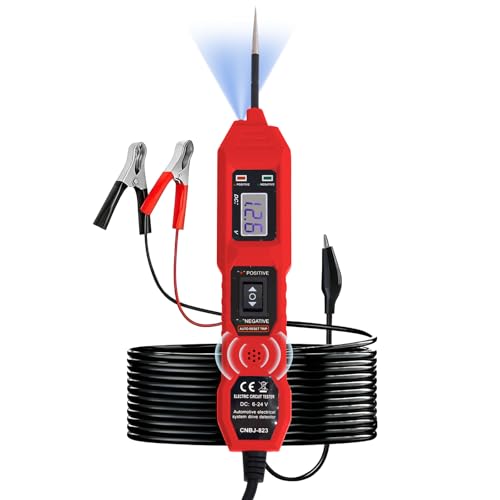
This 6V-24V automotive tester integrates multiple detection functions, including voltage detection, diode testing, continuity, ground detection, and short-circuit tracking. Its long 14.7-foot cable enhances reach, and an LED readout provides quick visibility. Overload protection helps safeguard both the tester and vehicle electronics. It’s a versatile choice for comprehensive electrical troubleshooting.
Who it’s best for: fleets, garages, and technicians who need an all-in-one solution. Why selected: broad functionality in one device reduces tool-switching. Caution: cable length can be cumbersome in tight spaces and requires careful handling to avoid tangling.
Buying Guide
What to look for when choosing an automotive electrical tester:
- Voltage range: Ensure the device supports the common automotive DC ranges you encounter (typically 6V-24V, with some models extending to 48V or 120V for specialized tasks).
- Display and readability: A bright LCD/LED display with clear numerals helps reduce misreads in dark engine bays. Consider 0.1V resolution for precise voltage readings.
- Polarity indicators: Red/green or similar dual-color indicators reduce mistakes when connecting probes to power sources.
- Probe design and guard: Stainless probes and protective sleeves improve durability and safety during use in tight spaces.
- Durability: A rugged housing and flexible leads are beneficial for workshop environments with grease, drops, and frequent handling.
- Specialized features: Some testers include audible alerts, backlit screens, or wire-tracing capabilities, which can save time on complex diagnostics.
FAQ
What is the main difference between a test light and a digital voltage tester?
A test light typically provides a simple on/off indication and sometimes polarity cues, while a digital tester shows precise voltage values and may include additional features like resistance or continuity checks.
Can I use these testers on household electrical circuits?
Most automotive testers are designed for 6-48V DC vehicle systems and are not recommended for household AC mains testing unless specifically rated for that purpose.
Why might a tester show inaccurate readings?
Check that leads are properly connected, ensure the device’s range is appropriate for the circuit, and verify the battery or source is delivering correct voltage. Follow the user manual for correct operation.
Is a long cable beneficial?
Yes, longer cables improve reach for testing in large engine compartments or behind panels, but they can be harder to manage in tight spaces. Use coil management as needed.
Do these testers protect vehicle electronics?
Many models include overload protection and polarity indicators to prevent incorrect connections, helping reduce the risk of damage during testing.