Answering the common buyer question: which electric bike conversion kit best fits your bike and riding style? This guide highlights five top options, suitable for different bikes, budgets, and goals. Each kit is described with who it’s best for, why it stands out, and a practical limitation to consider before you buy.
| Product | Wheel Type | Power | Best For |
|---|---|---|---|
| Loyalheartdy 20″ Front Wheel Kit | Front Wheel | 48V 1000W | Bikes with V or disc brakes and tight urban use |
| DDYOOK 28″/29″ Front Wheel Kit | Front Wheel | 48V 1000W | Higher speed on large-wheeled frames |
| LYNICESHOP 350W 26″ Kit | Front Wheel | 36V 350W | Budget-friendly conversion on standard 26″ bikes |
| CUBELLIN 26″ Rear Hub 2000W | Rear Wheel | 72V 2000W | High-power, performance-heavy builds |
| IMAYCC 100cc Gas Engine Kit | Bike Engine Kit | 100cc gas | Non-electric enhancement for legacy setups |
LOYALHEARTDY 20″ Front Wheel Electric Bike Conversion Kit

Best for compact bikes and urban riders who want immediate throttle-assisted power. This kit uses a 48V 1000W brushless hub motor with a 5-magnet pedal assist sensor and an SW-810LED display for at-a-glance status. It supports both V-brake and disc brake setups and has a front-fork open size of about 100 mm. The setup favors riders who prioritize strong acceleration and a straightforward installation on smaller wheels.
- Best for: Small to mid-sized bikes, city commuting, and riders who want strong torque from a front-drive motor.
- Why selected: High power output and a clear display, with compatibility for common brake types.
- Caution: Correct wire color matching in the controller is essential to avoid damage.
DDYOOK 28″/29″ Front Wheel 1000W Kit With LCD

This kit is a strong option for riders on larger frames, offering a 1000W brushless hub motor and a responsive 5-speed assist, plus a multi-function LCD that shows speed, distance, and battery status. It’s well-suited for riders who want high-speed capability and a robust rear- or front-wheel conversion that still feels smooth at speed.
- Best for: Larger wheel bikes (28″, 29″) and riders seeking a balance of speed and control.
- Why selected: Real-time display and cruise function for easier long rides.
- Caution: Ensure proper pedal-assist calibration and frame clearance to avoid rubbing.
LYNICESHOP 350W 36V E-Bike Conversion Kit Twist Kit

This lightweight option focuses on affordability and simplicity for many common bikes. The 350W motor provides a modest boost suitable for casual riders or those seeking an entry-level upgrade. The kit lacks integrated battery details in the listing, so battery compatibility should be confirmed before purchase.
- Best for: Budget-conscious riders upgrading older bicycles without heavy load needs.
- Why selected: Simpler installation and a compact power profile for basic improvement.
- Caution: Battery availability and compatibility are not specified; verify your power source fits the kit.
CUBELLIN 26″ Rear Hub 2000W E-Bike Kit
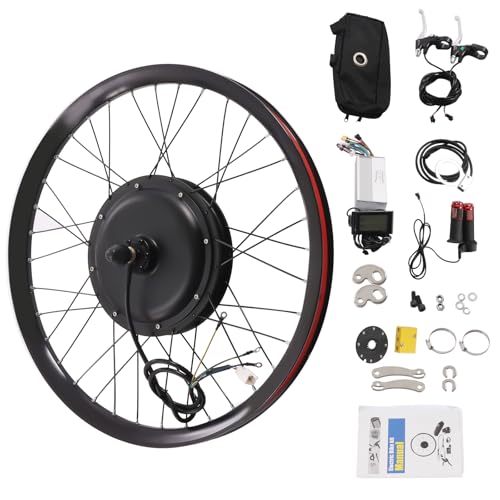
High-power rear-hub performance for riders chasing strong hill-climbing ability and fast acceleration. The 2000W motor (72V) delivers substantial torque and speed potential, with a durable aluminum wheel and a 9-gear system to adjust for terrain. This setup is best for riders who prioritize power and stability, and who have a compatible frame and battery.
- Best for: Enthusiasts and riders who tackle steep terrain or require quick bursts of speed.
- Why selected: High torque and multi-gear adjustment support diverse riding conditions.
- Caution: Higher voltage and motor power demand careful electrical and drivetrain integration.
IMAYCC Bike Motor Kit 100cc Gas Engine

This kit represents a non-electric conversion option for bikes that already rely on internal combustion. It’s designed for riders who want a motorized boost without relying on battery power. The kit includes a 2-stroke engine with a foot-start method and a CDI ignition. It’s best for enthusiasts who prefer mechanical torque and longer-running fuel availability.
- Best for: Riders seeking a gasoline-powered upgrade on older bikes.
- Why selected: provides a different propulsion approach for riders avoiding electric systems.
- Caution: Gas-powered kits require fuel management, maintenance, and regulatory considerations for on-road use.
Buying Guide
What should you consider before buying an EV bicycle conversion kit?
- Bike compatibility: Check wheel size, brake type, dropout spacing, front vs rear hub, and fork clearance to ensure a proper fit.
- Power needs: Higher wattage delivers faster acceleration but demands appropriate battery capacity and weight handling.
- Battery and range: Confirm battery compatibility, capacity, and charging requirements to match your typical ride distance.
- Controller and sensors: Ensure the controller is compatible with your display and pedal-assist sensor type for smooth ride feel.
- Installation effort: Some kits are straightforward for DIY installers; others need more technical setup or professional help.
- Safety and legality: Verify local laws on electric bike power limits and required equipment like lights and reflectors.
- Maintenance: Brushless motors generally require less maintenance than brushed options, but wiring and bearings still need care.
Quick comparison questions
- Which kit is best for dense city riding? The 20″ Loyalheartdy front-wheel kit offers strong torque in a compact package for small bikes.
- Which kit suits large wheel bikes for higher speeds? The 28″/29″ DDYOOK front-wheel kit provides broad compatibility with bigger frames.
- What if I want budget-friendly upgrade on a 26″ bike? The LYNICESHOP 350W kit is a cost-conscious option with essential features.
- Which option provides high power for hills? The CUBELLIN 26″ rear hub 2000W kit emphasizes torque and speed on demanding routes.
- Is a gasoline kit ever a good substitute? IMAYCC’s 100cc gas kit serves riders seeking a non-electric approach with different maintenance needs.
FAQ
- Do conversion kits require professional installation? Some do; others are DIY-friendly. Check the manual for required tools and expertise.
- Can I reuse my existing battery? Many kits require a compatible battery; verify voltage and capacity with the kit specifications.
- Will installing a kit affect my bike’s braking performance? Upgrading to electric power can change weight distribution; inspect brake setup after installation.
- What should I do if the controller wiring is unclear? Refer to the kit’s wiring diagram and color-coding; incorrect connections can damage components.
- Are there legal restrictions on power output? Laws vary; confirm local regulations regarding motor wattage and speed limits for e-bikes.
- Do rear-hub kits affect gearing or chain alignment? Some kits alter chainline; check sprocket alignment and frame compatibility during installation.