For crawl space work, a sturdy floor jack system is essential. These jacks stabilize beams, joists, and supports, helping homeowners address sagging floors and uneven foundations. This guide highlights five durable options, suitable for DIYers and pros alike, with clear comparisons to aid quick decisions.
Summary table of selected products:
| Product | Best For | Load Capacity | Height Range | Notes |
|---|---|---|---|---|
| VEVOR House Floor Jack | Heavy lifts and wide ranges | 18,000 lbs | 19″–36″ | High capacity; tool-free height adjustment |
| QARCMQ Jack Posts Crawlspace | Wide tall adjustments | 10,000 lbs | 16.5″–30″ | Anti-rust coating; robust steel |
| B4B BANG 4 BUCK House Jacks (16″–21″) | Compact spaces with fine tuning | 11,023 lbs | 16″–21″ | Top swivel for alignment |
| ASTAMOTOR 6 Pack Jacks | Multiple point support | 6 tons (12,000+ lbs) | 11″–16″ | Galvanized; easy install |
| Alffun 4 Pack Jacks | Stabilizing small spaces | 4,409 lbs each | 6″–9.5″ | Pre-drilled plates for anchoring |
VEVOR House Floor Jack: 19″–36″ Height, 18,000 Lbs

Best for heavy-duty lifting in larger crawl spaces. This jack uses robust Q235 steel and supports up to 18,000 lbs, making it suitable for substantial beam and joist work. The height range from 19″ to 36″ provides flexibility when working under tall crawl spaces or in elevated basements. The design emphasizes straightforward height changes by turning a lever, and it includes two lock pins for secure positioning. Choose this if you need maximum load-bearing capacity and wide height adjustability in a single unit. A potential limitation is the broader footprint, which may be less ideal in very tight crawl spaces.
QARCMQ Crawlspace Jack Posts: 16.5″–30″ Range

Best for versatile ceiling and floor leveling in mid-to-tall crawl spaces. This carbon steel jack post supports up to 10,000 lbs and offers a wide adjustment range (16.5″–30″). Its construction emphasizes anti-deformation performance under heavy loads, making it suitable for professional-grade stabilization. It also features anti-rust coating for durability in damp environments. Choose this if you need a tall, sturdy post with good corrosion resistance and a strong mid-range load capacity. A caution: ensure compatible base and top plates for your exact framing setup.
B4B BANG 4 BUCK Jacks: 16″–21″ Range (2 Pack)

Best for tight crawl spaces with precise height needs. These 11,023-lb capacity jacks feature M22 safety locking screws and a swiveling top plate to align quickly in irregular spaces. The 16″–21″ height range is ideal for standard crawl spaces without excessive height. Use this if you want reliable top-plate alignment and a compact solution. A limitation: smaller height range than taller models may require additional components or plan adjustments in higher joist settings.
B4B BANG 4 BUCK: 21″–43″ Height Range
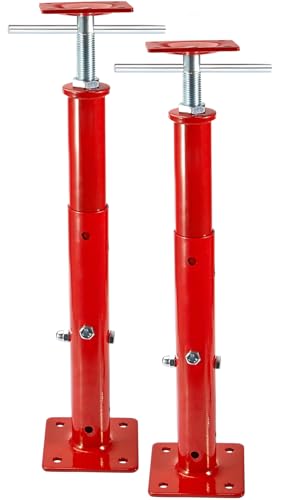
Better for higher crawl spaces and ceiling-to-floor leveling tasks. This 21″–43″ model shares the same rugged construction and 11,023-lb capacity as smaller siblings, with an emphasis on extended height. It is suitable for larger foundations and attic-to-crawl interventions where extended reach is critical. Choose this if your project involves tall joists or higher elevations. A caution: the taller unit may require more space to operate safely in cramped crawl spaces.
NAXVIO 11″–17″ Adjustable Jack

Best for mid-small stacks in limited spaces. The NAXVIO jack has an 11″–17″ adjustable range and a 10,000-lb safe load capacity, making it a solid option for moderate lifting tasks across crawl spaces. It features a swivel top plate for alignment and a straightforward turn-bar operation. Use this if you need a compact, reliable jack for smaller projects or where space is at a premium. Limitation: the load rating is lower than many larger models, so plan accordingly for heavier floors or beams.
Buying Guide: Key Considerations And Comparisons
- Load capacity: Match the jack’s rated pounds to the heaviest beam or joist you’ll support. For typical crawl spaces, 10,000–18,000 lbs covers most scenarios, but verify the actual loads in your project.
- Height range: Consider the minimum and maximum heights you’ll encounter. Taller ranges (e.g., 19″–36″ or 16.5″–30″) provide flexibility for high crawl spaces, while shorter ranges suit compact setups.
- Top plate design: A swiveling top plate improves alignment in uneven spaces, reducing the effort required to seat jacks properly.
- Material and finish: Steel with anti-corrosion coatings extends life in humid crawl spaces. Look for galvanized or coated posts for durability.
- Number of units: For larger projects, a multi-pack can save time and ensure consistent support across multiple points. For smaller tasks, a couple of units may suffice.
- Ease of use: Tool-free height adjustment and locking mechanisms speed setup while reducing the risk of shifting during work.
Frequently Asked Questions
- What should I consider first when choosing a crawl space jack? Focus on load capacity, height range, and the number of jacks required for stable support.
- Can these jacks be used for permanent foundation work? Yes, many are designed for temporary or semi-permanent stabilizing tasks, including crawl spaces and attic beams.
- Is a high load capacity always better? Not always. Choose a capacity that exceeds your heaviest load plus a safety margin, and consider space constraints and reach requirements.
- Do I need to bolt or anchor these jacks? Some models include pre-drilled plates for anchoring; verify the base and top plates fit your framing and local codes.
- How many jacks should I use for crawl space leveling? A common rule is to place jacks at strategic support points under beams or joists, typically spaced to prevent sagging while maintaining even load distribution.
- Are these jacks suitable for professional contractors? Many models are robust enough for professional use, but always ensure you follow manufacturer guidelines and local building standards.