Answering the need for accurate fuel system testing, these gauges measure fuel pressure at the rail or related ports. They’re best for mechanics, DIY enthusiasts, and previewing fuel delivery issues. This guide highlights five reliable options, explains who each is best for, and shows how to compare features like scale range, materials, and install fittings. Use this overview to choose a gauge that fits your engine type and maintenance needs.
| Product | Pressure Range | Best For |
|---|---|---|
| SENCTRL 0-100 Psi | 0-100 psi | Inline testing on gasoline systems and regulators |
| AUTOWN 0-140 PSI | 0-140 psi | Comprehensive tester kit for mixed fuel ports |
| CYONRUAN Universal | 0-100 psi | Compact, versatile gauge for standard carburetor/fuel rail tests |
| BETOOLL 0-140 PSI | 0-140 psi | Wide compatibility with various engines and vehicles |
| GLowShift 100 PSI | 0-100 psi | GM LS family rail testing with rail-adapter options |
SENCTRL 0-100 Psi Gauge For Fuel And Oil

SENCTRL’s 0-100 psi gauge uses brass and stainless wetted parts for measuring non-corrosive liquids, including fuel. It features a glycerin-filled mechanism to reduce pointer flutter and endure vehicle vibrations. The 1-1/2″ dial sits in a corrosion-resistant 304 stainless steel case and offers a simple single-scale readout. Best for inline fuel pressure testing with regulators or testers. Caution: accuracy tolerance is ±3/2/3% across the range, and it is optimized for light to moderate vibration environments.
0-140PSI Fuel Pressure Tester Kit
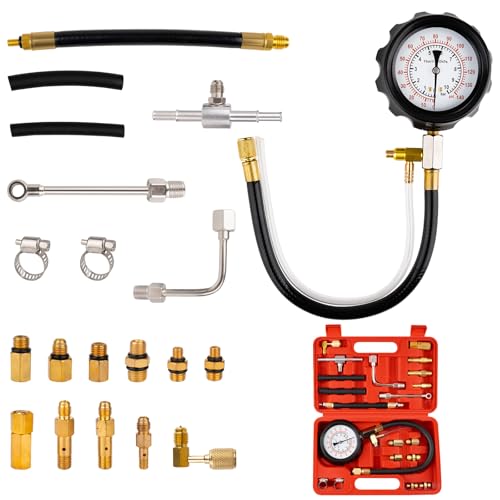
This tester kit covers a broad 0-140 psi range and includes multiple adapters for cars, trucks, motorcycles, and RVs. It helps diagnose fuel supply and injector issues with dual-color coded scales. Best for users needing wide compatibility and a robust selection of adapters. Limitation: some vehicle models or specific injector systems may require adapters not included in the kit, so verify fit before purchase.
AUTOWN 0-140PSI Fuel Pressure Tester Kit
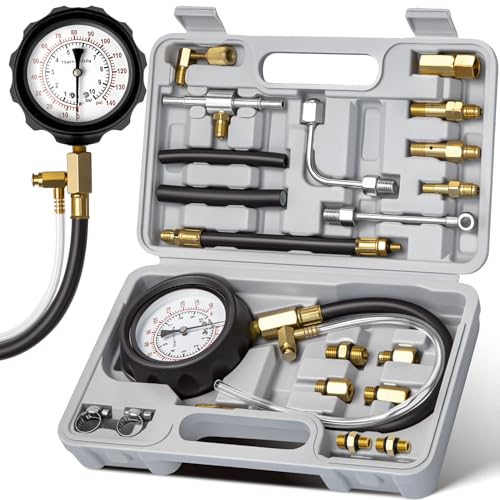
AUTOWN offers a dual-scale gauge with 0-140 psi and 0-10 bar for precise testing, plus an OEM-grade build using brass, aluminum, and steel components. It includes an eight-adapter set and quick-release hoses for easy testing on various fuel ports. Best for shops needing a complete kit with flexible compatibility. Caution: verify port thread size and vehicle model compatibility if you’re working on specialized engines.
Universal Fuel Pressure Gauge 0-100Psi

CYONRUAN’s compact gauge measures 0-100 psi with an AN6 black anodized fitting. The needle stability is aided by a liquid-filled mechanism, making it useful for steady readings during engine operation. Best for tight engine bays or when a smaller gauge is preferred. Limitation: the kit’s value depends on the included fittings; confirm port compatibility before buying.
BETOOLL 0-140PSI Fuel Injector Tester Kit

BETOOLL includes adapters, hoses, and fittings that cover most fuel injection systems, suitable for cars, motorcycles, trucks, SUVs, ATVs, and RVs. It is designed for repeat use with durable materials. Best for broad, cross-brand testing. Caution: some models are excluded by the manufacturer; verify compatibility with your vehicle’s valve size and pressure specs.
Buying Guide
What should you consider when choosing a fuel pressure gauge for a fuel rail?
- Pressure range: Match the gauge range to your engine and fuel system. Most gasoline systems fall within 0-140 psi; smaller engines may operate at lower pressures.
- Connection and fittings: Check NPT threads (1/8″ NPT is common) and adapter availability. Ensure compatibility with your fuel rail ports and quick-connects.
- Construction and durability: Liquid-filled gauges reduce flutter and vibration effects. Stainless steel or brass wetted parts improve longevity in fuel environments.
- Kit contents: Some models include multiple adapters and hoses. A broader adapter kit is beneficial for mixed fleets or custom rails.
- Accuracy and readability: Look for gauges with clear scales and documented accuracy within the expected operating range.
- Installation scenario: Decide between inline, back-mount, or rail-adapter configurations based on engine bay space and access.
Practical comparison questions
- Do I need a broad 0-140 psi range or a focused 0-100 psi gauge? Choose based on your vehicle’s typical rail pressure.
- Is a glycerin-filled gauge worth it for your setup? It helps stabilize the needle under vibration, useful for high-RPM engines.
- Should I choose a full tester kit or a single gauge? A kit saves time on port variety and future projects.
- How important is corrosion resistance in the gauge body? Stainless or plated bodies offer greater longevity in fuel environments.
FAQ
- What is a typical fuel rail pressure range for gasoline engines? Most are within 0-140 psi, though some systems may vary.
- Can I use these gauges with diesel engines? Some are not designed for diesel high-pressure systems; verify the product’s compatibility.
- Do these gauges require calibration? Most are designed to be read directly from the scale; specific calibration details depend on the model.
- What installation tools are needed? Depending on the model, you may need wrenches for fittings and adapters; many kits include what you need.
- Are liquid-filled gauges better than dry gauges? Liquid-filled gauges reduce flutter and protect the mechanism from vibration, improving stability.
- How do I verify compatibility with my vehicle? Check the vehicle’s manual for valve size, rail pressure specs, and port types, then compare with the gauge’s fittings and range.