Direct answer: a digital or analog tire pressure gauge is essential for maintaining tire health, fuel efficiency, and safety. This guide highlights top picks for everyday drivers, truckers, cyclists, and DIY enthusiasts. The best options balance accuracy, durability, and ease of use. The top five picks below are ideal for regular checks, with clear guidance on who benefits most from each model.
Summary table of selected products:
| Product | Best For | Key Benefit |
|---|---|---|
| AstroAI Digital Tire Pressure Gauge | Everyday car and light truck owners | Bright backlit display, 4 units, high accuracy |
| HYVOHEX Tire Pressure Gauge | Digital readers and quick checks | ANSI B40.7 Grade 2A accuracy, large LED backlit display |
| ETENWOLF Tire Pressure Gauge 0-75 PSI | Night-time or low-light use | Glow dial, durable construction, wide compatibility |
AstroAI Digital Tire Pressure Gauge 0-150 PSI

Best for drivers who want high precision and multiple units. This gauge is factory-calibrated to ±1 PSI and reads in 0.1 PSI increments, making it a solid choice for cars and light trucks. It offers PSI, Bar, Kgf/cm², and KPA, allowing easy cross-reference with various vehicle manuals and regional standards. The backlit display and nozzle light help when valves are hard to reach or in dim garages. Caution: ensure calibration is kept up to date for the most precise readings over time.
- Best for: daily drivers, road-trippers, and anyone who values clarity in dim lighting.
- Why selected: combination of accuracy, readability, and multiple units.
- Limitation: must rely on battery health for backlight (not a battery-powered concern, just note when reading in the dark).
ETENWOLF T300 Digital Tire Pressure Gauge 3-200 PSI

Best for users who operate at both very low and very high pressures, including trucks, bikes, and specialty vehicles. It is manually calibrated to ANSI B40.7 Grade 2A (±1 PSI) and is designed to perform across a wide pressure range. It also claims reliable operation across extreme temperatures, making it suitable for all-season use. Caution: Presta valve adapters are not included and may be needed for certain bicycle valves.
- Best for: multi-vehicle households and enthusiasts who need a wide range.
- Why selected: broad measurement range with reliable ANSI reference.
- Limitation: accessory compatibility notes for bicycles may require extra purchases.
AstroAI Pencil Tire Pressure Gauge 2 Pack

Best for compact storage and portable quick checks. This 2-pack uses a stainless steel body with an ANSI B40.1 Grade B (2%) calibration, and measures 10-75 PSI across three units (PSI, kPa, BAR). It includes extra valve caps for replacement. Caution: Do not exceed the maximum pressure rating to avoid damage to the gauge.
- Best for: compact tools with easy daily carry and quick readings.
- Why selected: rugged metal build and integrated deflator valve for convenience.
- Limitation: lower maximum PSI than some digital models.
Tire Pressure Gauge for Cars (ANSI Certified) – Analog Dial
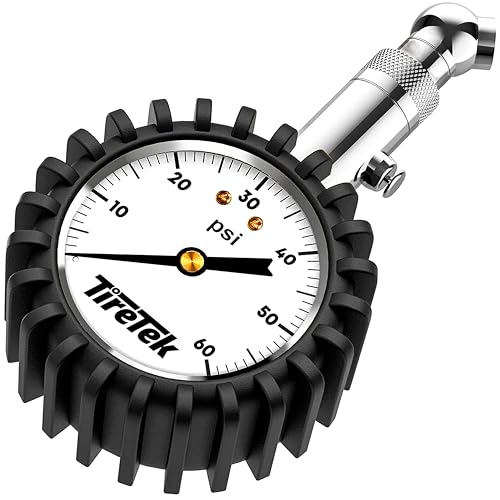
Best for traditional analog reliability and heavy-duty construction. This gauge uses steel and brass with a rubber cover for grip and durability, calibrated to ANSI B40.1 Grade A (2%). It works without batteries and is suitable for cars, motorcycles, trucks, bikes, SUVs, and more. Caution: analog readings require a steady hand and clean valve stems for accurate results.
- Best for: mechanics, hobbyists, and users who prefer analog readings.
- Why selected: robust construction and battery-free operation.
- Limitation: interpretation of readings may be slower than digital models.
JACO ElitePro Tire Pressure Gauge – 100 PSI
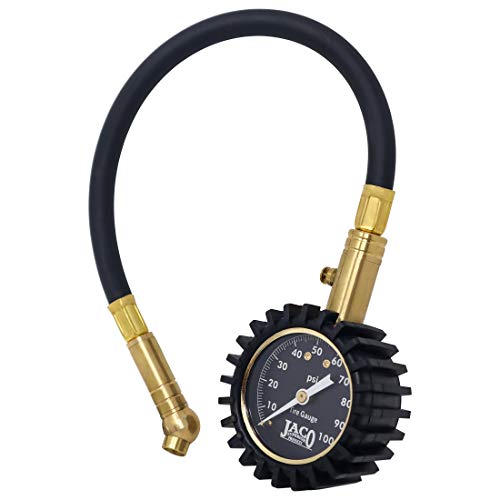
Best for professional-grade accuracy and rugged durability. The JACO ElitePro is ANSI standards compliant (±1.5%) and features a solid brass design with a protective guard and a 360-degree swivel chuck for easy valve access. It includes a leak-proof air hose and a built-in air bleeder valve to correct overinflation. Caution: higher accuracy relies on proper calibration and maintenance of the gauge’s integrity over time.
- Best for: technicians, fleets, and users who want professional-grade performance.
- Why selected: durable build and integrated features for precise control.
- Limitation: uses an air hose and guard that may feel bulky in tight spaces.
Buying Guide
What to consider when choosing a tire pressure gauge
- Measurement range: Choose a gauge that covers your typical pressures, including low ranges for bicycles or motorcycles and higher ranges for trucks.
- Accuracy: ANSI B40.1 or ANSI B40.7 references indicate trusted standards. Digital gauges often provide ±0.1–±1 PSI; analog gauges focus on overall stability and calibration.
- Display and readability: Backlit, glow dials, and large digits improve readability in dark garages or at night.
- Durability and materials: Metal bodies, brass components, and protective housings extend life in dusty or wet conditions.
- Valves and accessories: Integrated deflator, adapters, and caps can simplify use across vehicles and valve types.
- Power and maintenance: Digital models require battery management; analog models rely on mechanical accuracy and regular calibration checks.
- Portability: Pencil gauges and compact digital units are easy to carry in a glove compartment or toolkit.
Frequently Asked Questions
- What is a good tire pressure gauge accuracy?
Accuracy within ±1 PSI (or better) is generally considered good for most consumer use cases.
- Should I choose digital or analog gauges?
Digital gauges offer easy readability and features like backlights; analog gauges are battery-free and rugged.
- Can tire gauges be used for bicycles?
Yes, some gauges include valve adapters or have ranges suitable for bicycle tires; check compatibility first.
- How often should I calibrate a tire gauge?
Calibrate or verify calibration periodically, especially if the gauge is dropped or after extended use.
- Are there gauges with multiple pressure units?
Many digital gauges switch between PSI, Bar, kPa, and kgf/cm² for cross-reference with various devices.
- Is a high max PSI necessary for all vehicles?
No; most cars operate within 30–40 PSI, but trucks or specialized tires may require higher ranges.