If you’re choosing a gearbox or servo motor for robotics, RC projects, or Arduino builds, this guide helps you pick the right option. It highlights five solid choices, explains where each one shines, and notes practical limits. This is ideal for hobbyists, students, and DIY builders who need reliable, compatible components without overpaying.
| Product | Best For |
|---|---|
| Miuzei MG90S 9G Micro Servo Motor | Compact projects needing lightweight, precise micro actuation |
| Deegoo-FPV 4-Pack MG995 Servo Kits | High-torque applications and multiple actuators in one package |
| WWZMDiB SG90 Micro Servo | Arduino/Raspberry Pi experiments and small robotics |
| DORHEA 4Pcs SG90 Micro Servo | Budget-friendly micro servos for simple mechanisms |
| Miuzei 20KG Servo Motor | Higher torque RC and robot projects with larger loads |
Miuzei MG90S 9G Micro Servo Motor
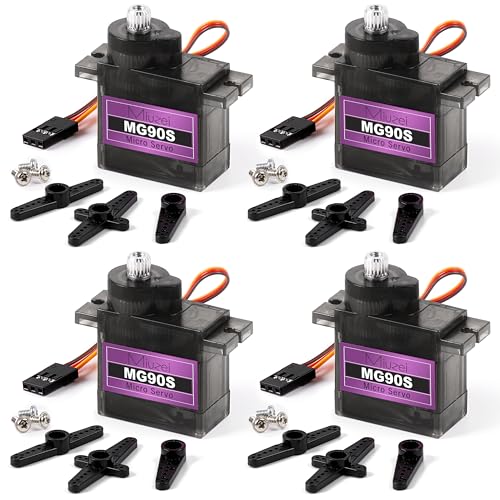
The MG90S Micro Servo Motor is a compact, metal-geared option designed for lightweight robots, RC models, and Arduino projects. Stall Torque is up to 2.0 kg·cm at 4.8V, with a speed of 0.11 seconds per 60 degrees at 4.8V. Operating range spans 4.8V–6V. It’s best for small actuations where space is limited and precision matters. A stable 5V supply is recommended for smooth performance. Caution: if used with high current loads, ensure your power supply remains within safe limits to avoid heat buildup.
Deegoo-FPV 4-Pack MG995 Servo Kit

This 4-pack centers on the MG995-style digital servo, offering high torque for robotics and remote-controlled projects. The servo supports 180-degree rotation (about 90 degrees each direction). Stall torque is around 13 kg·cm at 6V, with speeds of 0.17 s/60° at 4.8V and 0.13 s/60° at 6V. It’s well-suited for multiple-actuator assemblies and larger hobby robots. Best for: projects needing sturdy, mid-to-high torque servos in several channels. Caution: verify your power supply can safely deliver current for several servos simultaneously.
WWZMDiB SG90 Micro Servo Kit

The WWZMDiB SG90 kit targets Arduino and Raspberry Pi projects with a 4.8–6.0V range and a 180° operational span (approximately 500–2500 μs). It’s a good match for light-duty robotics and DIY controllers where compact size matters. Best for: beginners and small prototypes. Limitation: performance can vary with voltage supply quality; ensure a stable supply for consistent results.
DORHEA 4Pcs SG90 Micro Servo

This set includes four SG90-style micro servos featuring 9G gear motors and a 4.2–6V operating window. With a 1.6 kg·cm torque at 4.8V and a response around 0.3 seconds per 60°, these actuators are ideal for simple mechanisms, educational kits, and light RC projects. Best for: cost-conscious users building multiple small mechanisms. Caution: long-term use under heavy loads may reduce precision and lifespan.
Miuzei 20KG Servo Motor High Torque

The Miuzei 20KG servo delivers high torque suitable for larger RC vehicles, robotics, and heavy-duty mechanisms. It uses a robust metal gear design, supports 270° rotation, and features a programmable pulse width range from 500 μs to 2500 μs for 0° to 270°. It includes anti-burning and rotor-block protection, plus overload and overheat safeguards. Best for: projects requiring stronger actuation and extended duty cycles. Caution: higher torque can demand more substantial power and more careful mechanical mounting.
Buying Guide
What size and torque do you need?
Choose micro servos (like SG90 or MG90S) for compact robots and lightweight mechanisms. For larger loads or moving arms, a 20KG class servo or digital high-torque models are more appropriate. Always ensure the torque rating matches your load and lever length.
Power supply considerations
Most hobby servos operate around 4.8–6V. A stable supply reduces jitter and heat. If multiple servos run at once, consider a dedicated power source to prevent voltage drops that degrade performance.
Servo type: analog vs digital
Digital servos typically offer quicker response and stronger torque at the cost of higher current draw. For precise robotics or faster control loops, a digital option (like MG995) can be advantageous. If you’re new to projects, an analog SG90 may be more forgiving and cheaper.
Gear material and durability
Metal gears generally provide higher torque and longer life under load, while plastic gears keep costs down and reduce weight. For high-torque or outdoor use, prioritize metal-geared servos or gearboxes with protective features.
Mounting and compatibility
Check shaft sizes, mounting holes, and connector types to ensure compatibility with your frame, motors, or control board. Some gearboxes are designed to fit 60 mm servo motors with 14 mm shafts; confirm flange and shaft specs for your project.
Control and integration
Consider how you’ll drive the servo: PWM signals, microcontroller compatibility, and available libraries. For custom builds, verify pulse width ranges and any needs for calibration or protection features.
Maintenance and protection
Look for features like overload protection, anti-burn settings, and rotor-block safeguards. Regular inspection of gears, mounting hardware, and cable strain helps extend life in hobby projects.
FAQ
- What torque do I need for a small robotics project?
For lightweight arms or grippers, 3–6 kg·cm is often enough. For small vehicles or lifting modest loads, 6–12 kg·cm is common. - Are metal gears worth it?
Yes, for higher torque, longer life, and more demanding conditions. They’re typically more durable than plastic-geared servos. - Can I power multiple servos from one supply?
Yes, but ensure the supply can handle peak current and avoid voltage drops. A separate regulator or power bus is often beneficial. - What’s the difference between 0° to 180° vs 270° rotation?
180° servos are standard for many RC and hobby projects. 270° servos expand motion ranges for more complex mechanisms but may require more careful control to avoid mechanical interference. - How do I choose between SG90 and MG995?
SG90 is compact and inexpensive for light tasks. MG995 offers higher torque and speed for medium-duty applications, but consumes more power and is physically larger. - Is a higher voltage always better?
Not necessarily. Servos are rated for specific voltage ranges. Use within the recommended range to avoid overheating and shortened life.