Power reliability matters for mobile detailers who depend on electricity for pressure washers, polishers, and lighting. This guide highlights five portable generators ideal for mobile detailing, balancing runtime, noise, and fuel options. Best for RV trips, on-site detailing, or quick-backup power, these picks help keep equipment running without dragging around heavy gear. The top picks below are selected for clean power, portability, and practical runtime for fieldwork.
Oxseryn Power Equipment 4400W Inverter Generator

Best for: RV users and home backup where clean, stable power is needed for electronics. This model delivers 4400 peak watts and 3400 running watts, with 14-hour runtime at 25% load and ECO mode for efficiency. It includes 2x120V AC ports, a 12V DC port, and an RV outlet, making it a versatile on-site power source for detailing equipment. One limitation is a 2-gallon fuel tank, which requires planning for longer jobs without refueling.
PowerSmart 3600-Watt Portable Inverter Generator

Best for: Light-to-moderate power duties during mobile detailing, including charging stations and smaller tools. This model provides 3600 starting watts and 3200 running watts from a 149cc OHV engine. It uses advanced inverter technology to deliver a clean sine wave with less than 3% THD, suitable for sensitive electronics. It runs up to 8 hours on a 1.3-gallon tank at 25% load. A potential drawback is limited runtime for longer outdoor jobs without refueling.
Oxseryn 4400-Watts Open Frame Inverter Generator
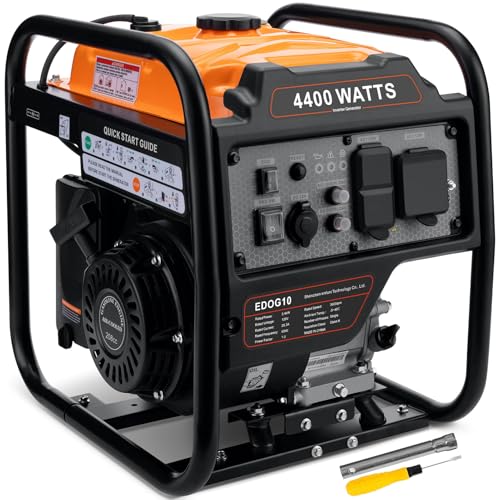
Best for: Mobile detailers needing higher surge power for heavy-duty tools and RV setups. This generator outputs 4400 peak watts and 3400 running watts, with multiple outlets (2x120V, 1x30A RV, 1x12V) and a 14-hour runtime at 25% load. It features ECO mode and overload protection. Choose this if you need robust power for peak loads, but be aware of the 2-gallon tank and potential noise sensitivity relative to ultra-quiet models.
WEN Quiet 4800-Watt Inverter Generator (56477i)

Best for: Detailers who prioritize quiet operation and clean power for sensitive electronics. The 56477i provides up to 4800 surge watts and 4000 running watts with inverter technology producing a clean sine wave. It includes a CO shutdown feature to enhance safety in enclosed or semi-enclosed work areas. The unit’s noise level is designed to be friendlier for mobile work, but it may still be louder than ultra-quiet models under load.
PowerSmart 4800-Watt Portable Inverter with Wheels

Best for: Detailing teams needing easy transport and RV-ready power. This 4800-watt inverter offers a 223cc OHV engine, clean power with less than 3% THD, and a wheel-and-handle kit for convenient mobility. Its noise level at quarter load is around 69 dBA at 23 feet, making it suitable for calm on-site operation. The trade-off is similar to other mid-range models: runtime depends on load, and heavier units may require frequent refueling on large jobs.
Buying Guide
What power output do I need for mobile detailing?
Consider both starting watts and running watts. Tools like pressure washers, heat guns, and buffers demand higher surge watts. Choose a model with ample peak watts to avoid overloading during startup. For basic lighting and charging, running watts are more critical.
Is inverter power necessary for my equipment?
Inverter generators deliver clean, stable power suitable for sensitive electronics and chargers. If you regularly power laptops, phones, or digital gauges, an inverter model reduces the risk of voltage spikes and frequency fluctuations.
How important is runtime and fuel capacity?
Long runtimes reduce refueling trips between jobs. Look for larger fuel tanks and ECO/low idle modes to maximize efficiency. If you work in remote areas, plan for extra fuel or a generator with extended runtimes at low loads.
Noise and portability considerations
Heavier-duty units can be louder; if you operate in quiet zones or close to clients, prefer models advertised as quiet or with noise-reducing features. Wheel kits and compact footprints improve transportability for mobile work.
Safety and maintenance features
CO shutdown sensors, oil protection, automatic low-oil shutdown, and easy access maintenance points help reduce risks and downtime. Ensure proper ventilation when operating in enclosed spaces or vehicles.
Which model should I choose?
- Best overall power for mobile detailing on RV sites: Oxseryn Power Equipment 4400W Inverter Generator (first product).
- Best for compact setups with good fuel efficiency: PowerSmart 3600-Watt Portable Inverter Generator (second product).
- Best for higher peak loads and RV-ready outlets: Oxseryn 4400-Watts Open Frame (third product).
- Best for quiet operation and electronics safety: WEN Quiet 4800-Watt Inverter (fourth product).
- Best for easy transport and strong all-around performance: PowerSmart 4800-Watt Portable Inverter with Wheels (fifth product).
Buying considerations at a glance
- Power needs: match starting watts to tools used on-site.
- Run time: assess expected job duration and refueling convenience.
- Portability: weight, wheels, and handle design impact field use.
- Power quality: inverter technology reduces risk to sensitive devices.
- Safety: look for CO detectors and automatic shutdown features.
FAQ
- Q: Do I need an inverter generator for mobile detailing? A: Inverter generators provide cleaner power, safer for electronics, which is beneficial for charging tools and devices.
- Q: How many outlets should I look for? A: At least two 120V outlets and, if possible, a 30A RV outlet for heavier equipment use.
- Q: Is 4,000 running watts enough? A: Many detail tools and chargers run well within 3,200–3,600 running watts; verify your combined load before purchasing.
- Q: What about fuel and runtime? A: Larger tanks and ECO modes extend runtime; plan for fuel availability when working remotely.
- Q: How noisy are these generators? A: Quiet models operate around mid-60s to low-70s decibels at a distance; consider job site noise requirements.
- Q: Are CO sensors important? A: Yes, CO sensors enhance safety in enclosed or semi-enclosed spaces during operation.