Looking for a reliable jump box to handle dead batteries, especially for cold starts or remote emergencies? This guide highlights five top options and explains who each is best for. These jump starters combine high peak amps, multi-protection features, and extra power banks, making them useful for everyday drivers, road-trippers, and small-workshop setups alike. The table below helps you compare essentials at a glance.
| Product | |||
|---|---|---|---|
| NOCO Boost GB40 | 1000A | Smaller vehicles and city driving | Ultrasafe spark-proof and reverse polarity protection |
| NOCO Boost GB70 | 2000A | All-gas and large diesel engines | Higher power for bigger engines and 8.0L capability |
| Scatach 3000A | 3000A | Heavy-duty or multiple vehicles | Strong 9.0L gas / 7.0L diesel support |
| TREKURE 8000A | 8000A | Extreme cold or frequent roadside use | Small form factor with high amperage and fast charging |
| JOLTEKON 4500A | 4500A | All-around emergency kit | Includes tire inflator and multiple modes |
NOCO Boost GB40: 1000A UltraSafe Jump Starter

Best for compact vehicles and urban drivers, the NOCO GB40 delivers 1000A peak power to start engines up to 6.0L gas or 3.0L diesel. It features patented spark-proof and reverse polarity protection, making connections safer for novices. The built-in power bank can recharge smartphones and tablets in about three hours, offering emergency charging when you’re away from outlets. This model is ideal for daily commuters who prioritize safety and portability. A minor limitation is that higher-demand diesel engines may require a higher-amp unit for repeated starts without recharging between uses.
NOCO Boost GB70: 2000A UltraSafe Jump Starter

The NOCO GB70 is designed for bigger engines, offering 2000A peak power suitable for up to 8.0L gas and 6.0L diesel engines. It uses the same Ultrasafe technology with spark-proof and reverse polarity protection and includes a portable power bank for on-the-go charging. Choose this for owners of larger vehicles, trucks, or frequent long trips where you might encounter tougher starts. The main caveat is its larger size compared to smaller units, which affects portability for some users.
Scatach 3000A Jump Starter

The Scatach model offers a strong 3000A peak, capable of starting up to 9.0L gasoline and 7.0L diesel engines. It’s designed for multiple starts per charge and supports a broad range of vehicles including boats and RVs. It includes intelligent protection to guard against sparks and wrong connections. Best for users who need a robust, all-terrain option for frequent use or larger vehicles. A limitation is the lower emphasis on ultra-compact form factor, which makes it slightly bulkier than mini-jump boxes.
TREKURE Car Jump Starter 8000A

The TREKURE unit brings a remarkable 8000A peak with 26800mAh, supporting engines from small cars to heavy diesel vehicles. It emphasizes speed with 18W fast charging and a compact design that’s easy to store. It includes three lighting modes for emergencies and a built-in handle for portability. This model suits frequent travelers or those who want fast, reliable starts in extreme conditions. The potential drawback is that very high-amp units can be heavier and pricier than mid-range options.
JOLTEKON Car Jump Starter With Air Compressor
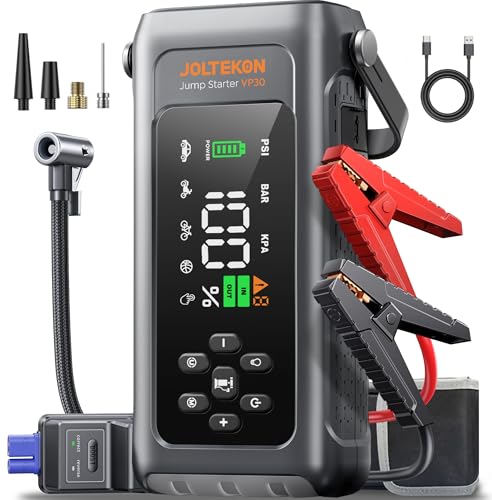
The Joltekon model combines 4500A peak power with an air compressor capable of inflating tires up to 150 PSI. It is designed for versatility, including a tire inflator and multiple output options for USB charging. Best for those who want an all-in-one kit for emergencies and roadside readiness. A potential limitation is that, while versatile, it may not deliver the raw starting power of the top-end18000+ amp models when repeatedly starting large diesel engines.
Buying Guide: Key Factors To Consider
What engine size do you need to start?
Match peak amps to your typical vehicle size. Smaller cars often start reliably with 1000–2000A, while larger trucks and diesels may require 3000–8000A or more for quick starts and reliability in cold weather.
How important is a power bank?
A built-in USB-C/USB-A port increases usefulness beyond starting, turning the device into a portable power bank for phones, tablets, and cameras. Check recharge time and total USB output for your needs.
What safety features matter?
Look for spark-proof connections, reverse polarity protection, and over-current protection. These features reduce risk during user error or poor cable connections, especially for beginners.
Portability vs. raw power
Smaller units are easier to store in a glove box or trunk, but may need more frequent recharges. Larger units provide higher peak amps and more jump starts per charge but are bulkier and heavier to carry.
Additional tools and accessories
Integrated LED lights, tire inflators, and multiple output ports increase versatility. Consider whether you want a dedicated tire inflator or extra lighting for nighttime emergencies.
FAQs
- Q: Can these jump starters start engines in freezing temperatures?
- A: Most models are designed for cold-start performance, but peak amps and battery chemistry influence effectiveness in extreme cold.
- Q: Do I need jumper cables if the unit has clamps?
- A: Yes, you still use the included clamps to connect to the battery terminals; the unit provides the output power.
- Q: Can I use a jump starter to power other devices?
- A: Many models include USB ports or wireless charging, but always verify output specs for your devices.
- Q: How many times can a jump starter be used per charge?
- A: It varies by model; some offer dozens of starts per charge, others fewer depending on engine size and charge level.