Find the right OBDII code reader and reset tool for your needs. This guide highlights five reliable options that cover basic code reading, live data, and MIL reset capabilities across common vehicle makes. It’s ideal for DIYers, car enthusiasts, and casual drivers who want quick ignition-to-diagnostics insight without visiting a shop. Below, you’ll see who each device is best for, along with practical pros and a brief limitation to consider. A quick buying table at the top summarizes key takeaways for fast comparison.
| Product | Best For | Notable Limitation |
|---|---|---|
| ANCEL AD310 | Budget-conscious DIYers needing fast codes and live data | Limited advanced diagnostics beyond basic OBDII |
| FOXWELL NT301 | Home mechanics who want EVAP and O2 sensor insights | Requires correct menu for some functions |
| VDIAGTOOL VD10 | Newbies who want a broad read/clear capability with I/M readiness | Interface may feel basic vs. premium models |
| ANCEL AD410 | Engine-focused readers needing quick code clear and EVAP checks | Not a full system reset for ABS/SRS |
| OBDMATE OM901 | Users who want ABS/SRS/Transmission diagnostics in one tool | May be heavier; extended features require practice |
ANCEL AD310 Classic Enhanced OBD II Scanner

The ANCEL AD310 is a compact, widely used OBDII scanner designed to read and clear emission-related codes quickly. It supports 1996 and newer vehicles with OBDII protocol and provides live data, freeze frame information, I/M readiness, and vehicle information. This device is best for DIYers who want a straightforward tool that plugs into the OBD port and powers directly from the car, with no separate battery required. The large display and clearly labeled buttons help ensure fast use between road trips or garage sessions. A key caution is that the AD310 focuses on core engine diagnostics and may not cover advanced systems like ABS or transmission in the same depth as higher-end models. If you need simple, reliable engine data, this is a strong pick.
FOXWELL NT301 OBD2 Scanner With Live Data

The NT301 offers robust OBDII diagnostics with the ability to read codes, check EVAP and O2 sensor status, view live data, and retrieve the VIN. It’s particularly suited for drivers who want more than basic DTC reading, especially those who aim to optimize fuel economy and emissions through deeper inspection. The model emphasizes proper operation by guiding users to ensure ignition-on state and correct menu choices for accurate results. It’s best for serious DIYers who value an expanded feature set and clear data presentation, with a limitation that comprehensive code clearing depends on fully repaired conditions before the MIL can be reset in some scenarios.
VDIAGTOOL VD10 OBD2 Scanner
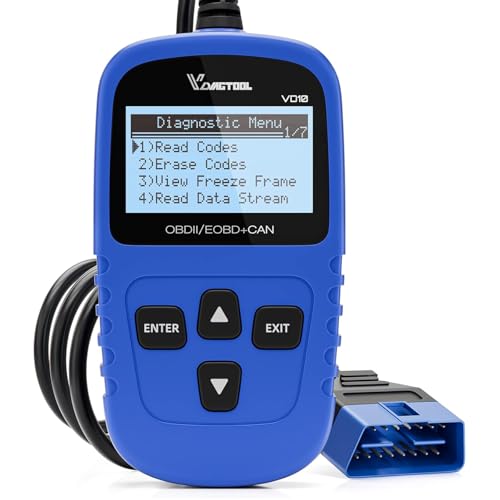
The VD10 is marketed as a must-have tool for DIYers, providing quick reads and clears for DTCs, I/M readiness, freeze frame, and VIN retrieval. It emphasizes ease of use: attach to the OBDII port and diagnose in seconds with a built-in database of more than 3,000 codes. Best for new car owners or hobbyists who want a straightforward, plug-and-play experience and a clear TFT readout. A limitation is that some advanced functions may not be as expansive as premium tools, but it excels in quick, everyday diagnostics and cost efficiency.
ANCEL AD410 Enhanced OBD2 Scanner

The AD410 focuses on enhanced OBDII diagnostics with broad vehicle compatibility, including CAN and multiple ignition standards. It quickly reads and clears stored emission-related codes, checks monitor readiness, and offers a large bank of DTC lookups to identify faults without external searches. It’s best for users who want a comprehensive engine-focused scan with multilingual support and straightforward use. Note: It does not reset all non-engine systems, so those seeking ABS/SRS resets should consider alternatives with those capabilities.
OBDMATE OM901 OBD2 Scanner With ABS SRS

The OM901 is designed to diagnose four key systems—ABS, SRS, Engine, and Transmission—alongside standard OBD2 functions. It presents a 3.5″ TFT display for easy interpretation of live data, supports VIN retrieval, and offers one-click I/M readiness checks. This all-in-one tool is best for users who want to address multiple vehicle systems from a single device, especially in vehicles where ABS or airbag diagnostics are a concern. A potential limitation is that its breadth can require more familiarity to navigate effectively, compared to simpler engine-only scanners.
Buying Guide
What should I look for in an OBDII code reader?
- Vehicle compatibility: Ensure the tool supports your car’s make, model year, and whether it uses CAN, ISO standards, or other protocols.
- Functionality: Decide if you only need DTC reading/clearing or additional features like live data, freeze frame, EVAP tests, O2 sensor tests, and VIN retrieval.
- Ease of use: Consider menu design, display readability, and whether the device is plug-and-play with no battery or updates required.
- System scope: If you want ABS, SRS, or transmission diagnostics, confirm the tool supports those subsystems.
- Data presentation: Look for clear data presentation, such as color-coded results, graphs for live data, and a robust DTC library.
Which tool is best for a specific user profile?
- Best for beginners: AD310 or VD10 for straightforward code reading and quick MIL management.
- Best for EVAP and emissions insight: NT301 or AD410, which offer enhanced diagnostic features beyond basic codes.
- Best all-in-one: OM901 for users who want ABS, SRS, Engine, and Transmission in one device.
How reliable is live data and VIN retrieval?
Live data and VIN retrieval are helpful for confirming suspected faults and ordering the right replacement parts. Look for devices with a well-maintained built-in thesaurus of DTC definitions and a readable 3.5-inch or larger display for easier interpretation on the spot.
Is there any risk in using an OBDII scanner?
OBDII scanners are designed to interface with the vehicle’s diagnostic port. Using them incorrectly or choosing a tool that tries to modify control modules beyond reading and clearing codes can pose risks. Always use a tool within its stated capabilities and disconnect after use.
What about price vs. feature balance?
Higher-priced models typically offer broader system coverage and more advanced features. For engine-focused tasks, a mid-range scanner with robust DTC lookup and live data is usually sufficient. For multi-system needs, consider tools that explicitly advertise ABS/SRS/Transmission support.
Common questions
- Can a basic OBDII reader turn off the check engine light? Yes, when the underlying issue is resolved; most devices perform a code clear only after repair.
- Do I need an internet connection? Most tools operate offline with an internal DTC database; online updates are optional but helpful.
- Can I use these on all vehicles? Most are compatible with 1996+ US vehicles and newer models; verify compatibility for your specific year and make.
- Is a larger screen better? A larger, easy-to-read display reduces misreading live data and improves user experience, especially for beginners.
- Will these reset all systems? Many tools focus on engine codes and some systems; verify each device if you need ABS/SRS or trans reset functionality.
- Do I need the tool to be powered from the port? Several models draw power directly from the OBDII port, so no extra battery is required.
Choosing the right OBDII code reader depends on your vehicle, your diagnostic needs, and how deeply you want to probe engine and related systems. The five models above offer a range of capabilities from quick code clearance to multi-system diagnostics, enabling more informed maintenance decisions and potentially faster issue resolution.