Looking for an oil pressure gauge that suits a motorcycle? This guide highlights top choices and helps you pick a model that fits your bike’s engine and riding style. The listed products span vibration-damped, stainless steel cases, and NPT fittings that fit common motorcycle ports. Best for everyday riders, seasoned builders, or performance enthusiasts, these options emphasize reliability, readability, and durability in demanding vibration environments.
Summary table of selected products
| Product | Brand | PSI Range | Best For |
|---|---|---|---|
| Mid-USA 100 PSI Oil Pressure Gauge 1/8″ NPT Fitting | Mid USA | 0–100 PSI | Standard motorcycle engines, classic builds |
| 60 psi Oil Pressure Gauge for Motorcycles – Shock Proof | Billet Proof Designs | 0–60 PSI | Harley models, bobbers, choppers |
| 100 PSI Oil Pressure Gauge with Adapter Fitting for Shovelhead & Big Twin EVO | Mid USA | 0–100 PSI | Shovelhead and Big Twin EVO plugs |
| MEANLIN MEASURE 0~60Psi Gauge 1/8″ NPT | MEANLIN MEASURE | 0–60 PSI | Back-mount installations on bikes |
| Marshall 60 psi Oil Pressure Gauge – Shock Proof | Billet Proof Designs | 0–60 PSI | Harley, bobbers, cafe racers |
Mid-USA 100 PSI Oil Pressure Gauge 1/8″ NPT Fitting Motorcycle (88004)

This 0–100 PSI gauge uses a 1/8″ NPT center-back connection with brass internals. Its compact 1.6″ case diameter and 1.75″ bezel fit many standard motorcycle dashboards. Best for classic and performance builds that require a compact, reliable readout.
Best for: riders seeking a compact, vibration-resistant gauge with straightforward installation for standard ports. Choose this if your bike uses an 1/8″ NPT back outlet and you want brass internals for durability.
Limitation: The data reflects basic construction details; check compatibility with your specific OEM or aftermarket fuel system fittings before installation.
60 psi Oil Pressure Gauge for Motorcycles – Shock Proof (Billet Proof Designs)

Stainless steel case with brass internals and silicone-filled dampening ensure reduced vibration readings. The black gauge face with a polished stainless steel bezel adds a clean look for Harley models, bobbers, and choppers.
Best for: riders who want a robust, vibration-damped gauge with a low-profile 60 PSI range, particularly on bikes prone to engine vibration. Better for classic Harleys and builds where appearance matters as much as function.
Caution: Silicone-filled gauges can be more challenging to service; ensure the sealing remains intact after long-term use.
100 PSI Oil Pressure Gauge with Adapter Fitting for Shovelhead & Big Twin EVO

0–100 PSI gauge designed for 1970/Later Shovelhead & Big Twin Evolution engines, featuring a vibration-resistant oil-filled stainless steel case and chrome bezel with a 1 3/8″ face diameter. It includes an adapter fitting for compatibility with specific shovelhead and Big Twin Evo ports.
Best for: builders upgrading Shovelhead or Big Twin EVO engines who want a dedicated adapter-compatible gauge with durable construction.
Limitation: The adapter fitting may require additional hardware or precise port matching; verify compatibility with your engine year and model before purchase.
Oil Pressure Tester Tool Kit – 0-140 PSI

This tester offers a dual-display pressure gauge head, a wide 0–140 PSI range, and a complete accessory kit with ten adapters to fit most brands and models. Use for cars, trucks, motorcycles, boats, and more when you need quick diagnostics or confirmation of oil pressure before or after engine work.
Best for: garages or riders who want a multi-vehicle diagnostic tool with broad compatibility. Choose this if you value a single kit that covers motorcycles and other engines.
Limitation: Primarily a diagnostic tool; for on-bike real-time monitoring, a dedicated motorcycle oil gauge with a 1/8″ NPT port is typically lighter and easier to install.
MEANLIN MEASURE 0~60Psi Glycerin Filled Gauge

Glycerin-filled, 1/8″ NPT, stainless steel 1.5″ dial face, back-mount installation. Designed for vibration damping with a movement to minimize readings under harsh conditions. Includes a 1/4″ NPT and 3/8″ NPT hex bushing for flexible mounting options.
Best for: riders seeking a robust, liquid-filled gauge with back-mount capability and multiple port options. Choose this if your bike has space for a slightly larger dial and requires strong vibration suppression.
Limitation: The back-mount design may require additional hardware or specific mounting brackets to fit certain frames or cockpit layouts.
Marshall 60 psi Oil Pressure Gauge – Shock Proof
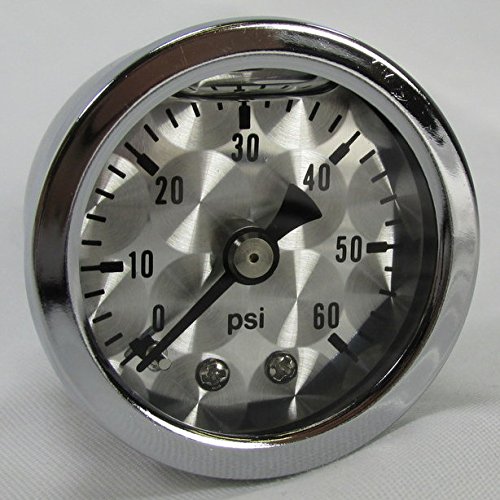
Stainless steel gauge case with brass internals, silicone-filled for vibration dampening, and an engineered-machined face with a polished stainless steel bezel. This gauge offers a classic, high-contrast appearance suitable for many Harley-style builds.
Best for: riders who want a visually appealing gauge with strong vibration control and a straightforward 60 PSI readout. Better for people prioritizing a traditional, machine-finished look on their instrument cluster.
Limitation: The 60 PSI range may be limiting for engines that run higher oil pressures; ensure this range matches your engine’s typical readings.
Buying Guide
- Port size and fitting: Most motorcycle gauges use 1/8″ NPT fittings. Confirm your engine or adapter compatibility before buying.
- PSI range: For most motorcycles, 0–60 PSI suits small-to-mid displacement engines; 0–100 PSI is common for larger or performance builds. Consider whether you need a broader range for diagnostics.
- Vibration dampening: Silicon or glycerin-filled gauges reduce needle flutter caused by engine vibration. This improves readability and durability over time.
- Mounting style: Back-mount, dash-mounted, or tank-mounted gauges require different spaces. Ensure the chosen gauge fits your bike’s cockpit or fairing design.
- Construction: Stainless steel or brass internals increase longevity in harsh riding conditions. Chrome bezels and machined faces add style but confirm compatibility with your aesthetic.
- Adapter availability: Some gauges include adapters for specific models (e.g., Shovelhead or EVO engines). Verify if you need an extra adapter to match your year and model.
Frequently Asked Questions
- What PSI range should I choose for a typical motorcycle? Most riders find 0–60 PSI sufficient for standard bikes; 0–100 PSI is useful for performance or older engines with higher idle pressures.
- Are silicone- or glycerin-filled gauges better? Both dampen vibration; glycerin-filled gauges often offer longer-term stable readings in heavy vibration environments, while silicone-filled models provide strong dampening with slightly faster needle response.
- Do I need a separate adapter for my engine? Some gauges come with adapters for common engines; others require purchasing an adapter separately. Confirm your model year and engine type before ordering.
- Can I use a standard automotive gauge on a motorcycle? Some can be adapted, but motorcycle ports differ in fittings and space. For reliable readings and easier installation, choose a gauge designed for motorcycles when possible.
- Is a high-quality gauge worth it? Yes. A well-made gauge with vibration dampening improves readability and durability, reducing the risk of inaccurate readings that could mask engine issues.