Seeking a reliable plug-in diagnostic tool for your vehicle? This guide highlights five popular OBD2 scanners that deliver clear fault-code reading, live data, and practical troubleshooting guidance. Each pick targets a different type of driver—from DIY enthusiasts to casual car owners—so you can choose the best match for your skill level and typical car maintenance needs. Below, you’ll find concise why-this-one-for-you statements, plus a quick product comparison to help you decide at a glance.
| Product | Best For |
|---|---|
| ANCEL AD310 | Everyday car owners who want a simple, reliable code reader for 1996+ vehicles |
| MOTOPOWER MP69033 | Users who want a broad protocol range and a larger display for quick checks |
| ANCEL AD410 | Users needing extensive compatibility and emissions testing features |
| UMEIJA V011 | Mobile readers who value app-based data and real-time visualization |
| VDIAGTOOL VD10 | DIYers who want a straightforward, code-based diagnosis with DTC lookup |
ANCEL AD310 Classic Enhanced Universal OBD II Scanner

The ANCEL AD310 is a compact, budget-friendly OBD II scanner that reads and clears emission-related codes for vehicles 1996 and newer. It provides quick access to live data, freeze-frame information, I/M readiness, and vehicle information without the need for external power sources. Best for: homeowners and hobbyists who want a dependable, plug-and-play tool to diagnose check-engine lights and clear codes after repairs. Limitation: it relies on vehicle OBD II port power and does not offer advanced system testing beyond standard emission-related data, so it may not reveal issues that require ABS, SRS, or transmission checks.
MOTOPOWER MP69033 OBD2 Scanner

The MP69033 offers broad protocol support across 9 OBD II standards, with a 2.8″ LCD that displays data clearly. It can read, erase codes, view freeze frame, monitor readiness, and provide live data. Best for: drivers with a mix of older and newer vehicles who want fast, readable results on a dedicated screen without a mobile app. Limitation: as a basic scanner, it doesn’t provide deep advanced functions like ABS/SRS testing or extensive bi-directional control.
ANCEL AD410 Enhanced OBD2 Scanner

The AD410 is a wide-compatibility OBD2 tool designed for 1996+ vehicles, including US, EU, and Asian models. It offers extensive DTC lookup with over 42,000 built-in definitions, MIL reset, and readiness checks. Best for: users who want a robust, all-mystems code reader with strong diagnostics and multilingual support. Limitation: it is primarily an engine-focused tool and does not support ABS, SRS, or other non-engine systems for diagnostic clearance.
UMEIJA OBD2 Scanner V011 Bluetooth
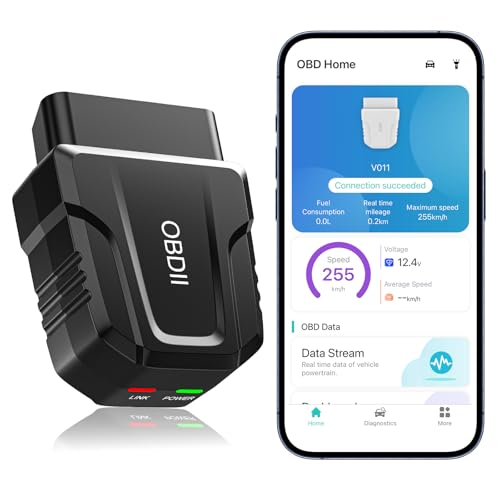
The V011 offers Bluetooth connectivity with iOS and Android, delivering comprehensive performance testing, live data streaming, and VIN retrieval. Best for: mobile users who prefer an app-driven experience and real-time visual data to understand vehicle performance. Limitation: reliance on a compatible smartphone app means user experience can vary with device and app updates; clearing codes may depend on repair completion for some models.
VDIAGTOOL VD10 OBD2 Scanner
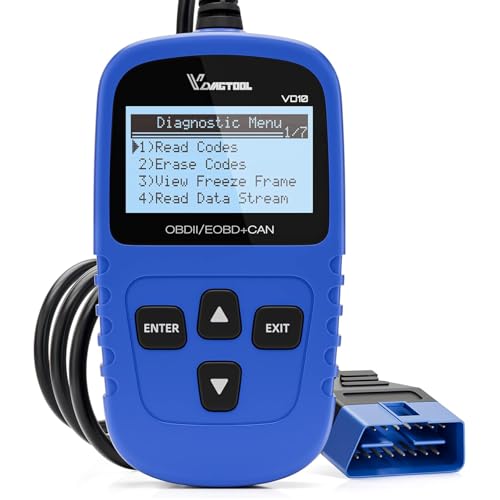
The VD10 is a DIY-friendly code reader that focuses on reading and clearing generic DTCs, viewing freeze frame, I/M readiness, and vehicle information. Best for: car owners who want a straightforward tool for quick code checks and diagnostics without extra bells and whistles. Limitation: the device emphasizes engine diagnostics and may not support advanced diagnostics for ABS or transmission systems on all models.
Buying Guide
Key considerations when choosing a plug-in diagnostic tool for cars:
- Vehicle compatibility: Ensure the scanner covers your vehicle year range and protocol (OBD II, CAN, etc.).
- Functionality: Decide between basic code reading/clearing and broader diagnostics, including live data, freeze frame, or I/M readiness.
- Display and usability: A larger, easy-to-read display helps with quick interpretation, especially in dim environments.
- Power source: Some scanners draw power from the OBD II port; others require a battery or external power for advanced features.
- Connectivity: Bluetooth or app-based tools are convenient for mobile use, but consider device compatibility and data visualization preferences.
- Language and database: A large built-in DTC library reduces online lookups and speeds diagnosis.
- Limitations: Some scanners cannot reset specific systems (ABS, SRS, transmission) or may require underlying repairs before code clearance.
How to pick quickly
- Basic readers for most cars with simple needs: choose a model like AD310 or VD10.
- Broad compatibility and advanced testing: AD410 or NT301-style tools are strong options.
- App-driven, real-time visualization: consider V011 for mobile-friendly diagnostics.
Comparison snapshot
- Best for simplicity: ANCEL AD310
- Best display and wide protocol: MOTOPOWER MP69033
- Best for comprehensive OBDII testing: ANCEL AD410
- Best for app-based data: UMEIJA V011
- Best value DIY tool: VDIAGTOOL VD10
Frequently asked questions
- Q: Do these scanners require a battery? A: Most plug-in readers draw power from the OBD II port; Bluetooth and some models may require power from the device the app runs on.
- Q: Can I clear codes for all systems? A: Many scanners clear engine codes; some do not support ABS or SRS resets. Check the feature list for each model.
- Q: Will clearing a code fix the problem? A: Clearing codes only removes the MIL; the underlying issue must be repaired before the code can be reliably cleared.
- Q: Do I need a professional to use these tools? A: Not necessarily. Most cleaners are designed for DIY use with guided menus and built-in code libraries.
- Q: Is live data necessary for diagnosis? A: Live data helps identify trends and root causes more efficiently, especially for intermittent issues.
- Q: Can I use these tools on multiple vehicles? A: Yes, most tools support multiple vehicles; verify protocol compatibility for each model before use.