When choosing a programmable multi-frequency TPMS sensor, look for models that cover the widest vehicle range, support multiple frequencies, and can be programmed with common TPMS tools. This guide highlights five USB-friendly options that aim to reduce service time and inventory, while offering reliable OE-like performance. Best for tire shops and DIY enthusiasts who want versatile, future-proof TPMS solutions.
The following quick-reference table summarizes the featured products, frequencies, and typical best-use scenarios. This is designed to help buyers compare at a glance.
| Product | |||
|---|---|---|---|
| Xtra-Seal Smart Sensor 17-43041 | Multi-frequency | High coverage (95%+) | High-volume shops needing broad compatibility |
| Silverback One-Direct TPMS (Set of 4) | 314.9/315/433 MHz | Near-OEM coverage | Single-SKU solution for many vehicles |
Xtra-Seal Smart Sensor 17-43041

Features: 95% vehicle application coverage; reduces TPMS service time; reduces inventory. This sensor is designed for broad compatibility and efficiency in service workflows. Best for large fleets or repair shops that service a wide mix of makes and models. Choosing this option helps minimize the number of SKUs needed and speeds up relearn processes. Caution: verify final compatibility with local vehicle models and ensure your TPMS tool supports the specific multi-frequency programming workflow.
Who it’s best for: High-volume tire shops, fleet services, and repair professionals who prioritize broad coverage and faster service time. Why selected: its extensive vehicle coverage and inventory savings align with shop operations that handle many different vehicles.
Limitations: Some programming steps may require compatible TPMS tools; always confirm tool compatibility before purchase.
Silverback One-Direct TPMS (Set of 4)

Features: Multi-frequency (314.9MHz, 315MHz, 433MHz); OE-level quality; supports auto-locate and future OE system technologies; builds on an automated platform with OEM-like standards. Vehicle coverage of 99.5% with a single universal SKU. Programs in seconds and uses a durable battery. Best for shops seeking a true universal SKU to streamline inventory and reduce relearn complexity. Caution: ensure your Ateq TPMS tool is compatible, as exact programming workflows can vary by tool.
Who it’s best for: Distributors and repair shops that want a single SKU capable of servicing most vehicles with fast programming. Why selected: near-OEM quality and broad frequency support help minimize parts churn and simplify stocking.
Limitations: Some users may need specific programming steps via compatible TPMS tools; confirm tool compatibility before purchase.
Silverback One-Direct TPMS (Set of 20)
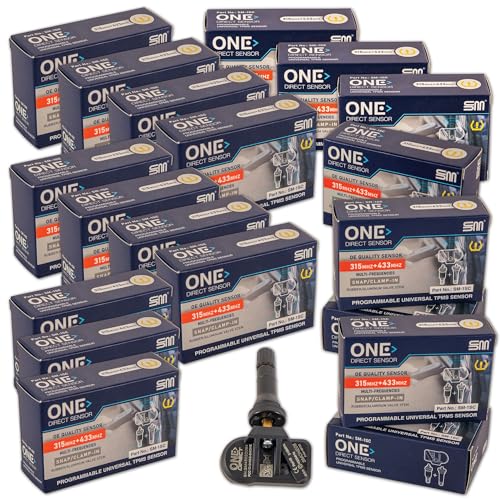
Features: Multi-frequency (314.9/315/433 MHz) with a single SKU; high vehicle coverage; similar OEM-grade quality as the 4-pack variant, designed for high-volume labs and repair shops. Best for shops aiming to optimize inventory by stocking one universal SKU for multiple customers. Why selected: large pack size reduces per-unit cost and simplifies stock management while preserving OE-like performance. Caution: bulk orders require careful handling to avoid counterfeit or mis-matched units if sourced from third-party sellers.
Who it’s best for: Tire shops and service centers performing frequent TPMS replacements for many different vehicles. Why selected: it combines broad coverage with cost-per-sensor advantages at scale.
Autel MX-Sensor 4-Pack (315/433 MHz)

Features: Dual-frequency 315MHz + 433MHz; 100% original sensor ID cloning; supports unlimited programming with compatible Autel tools; covers 99% worldwide vehicles when paired with Autel TPMS tools. Best for shops already using Autel tools seeking seamless programming and reliable cloning. Caution: requires compatible Autel programming tools to activate and relearn; not a universal standalone solution without software.
Who it’s best for: Shops and individuals already invested in Autel TPMS tooling who need a reliable, cloneable sensor with broad model coverage. Why selected: strong ecosystem compatibility and cloning capability help reduce relearn costs and installation time.
Limitations: Requires Autel TPMS programming tools for full activation and relearn processes.
Autel MX-Sensor 4-Pack (2-in-1, 315/433 MHz)

Features: Dual-frequency 315MHz/433MHz; 100% original sensor ID cloning; interchangeable rubber and metal valve stems; compatible with Autel MaxiTPMS tools for activation and relearn; claimed to cover 99% worldwide vehicles with broad factory-like performance. Best for high-volume shops that value quick installation and flexible valve options. Caution: like other Autel sensors, full benefits depend on using compatible programming tools and relearn workflows.
Who it’s best for: Shops needing a compact, dual-frequency sensor with easy valve adaptation and robust cloning. Why selected: 2-in-1 frequency and easy installation streamline stock management and service throughput.
Buying Guide: Key Purchase Considerations
- Frequency compatibility: Look for sensors that support 315 MHz, 433 MHz, and 314.9 MHz where applicable to maximize vehicle coverage.
- Vehicle coverage vs. SKU strategy: High-coverage universal SKUs reduce inventory complexity, but verify tool compatibility for cloning and relearn workflows.
- Valve stem options: Rubber vs. metal valves affect installation time and compatibility with certain rims; ensure the sensor matches your customers’ wheel types.
- Programming tools: Some sensors require specific TPMS programming tools for activation, cloning, and relearn; confirm tool alignment before purchase.
- Quality and OEM alignment: Sensor quality and OEM-like features (auto-locate, data replication) improve reliability and reduce comebacks.
- Scalability: For shops with high tire volumes, consider multi-pack options to lower per-unit costs and simplify stock management.
Frequently Asked Questions
- What does “multi-frequency” mean for TPMS sensors? It means the sensor can transmit on multiple standard frequencies (for example, 315 MHz and 433 MHz), allowing compatibility with a broader range of vehicles.
- Do I need special tools to program these sensors? Yes. Most universal sensors require TPMS programming tools to activate, clone, and relearn the sensor in the vehicle.
- Can one universal SKU replace multiple OEM sensors? In many cases, yes. Universal sensors are designed to cover most makes and models, reducing the need for dozens of OEM SKUs.
- Are metal-valve sensors better than rubber-valve sensors? It depends on wheel and vehicle requirements. Metal-valve sensors are often more durable for heavy use, while rubber valves are common and easier to replace.
- How important is vehicle coverage when choosing a sensor? Higher coverage reduces the need to stock many different sensors and speeds up service, especially for shops serving diverse customers.
- Can these sensors be programmed through the tire without removing the wheel? Some sensors offer strong signal performance that allows programming with the tire mounted, but this depends on the specific sensor and tool in use. Always follow the tool and sensor manufacturer guidance.