Explore hands-on V8 engine model kits that actually run, offering a blend of education and entertainment. This guide highlights five top options, detailing features, parts, and what buyers should consider to choose the best kit for hobbyists, students, or professionals.
| Product | Brand | Key Feature | Approx. Parts |
|---|---|---|---|
| Playz V8 Combustion Engine Model Kit That Runs | Playz | Working visible V8 with engine sounds | 270 parts |
| Suplanet V8 Engine Building Kit That Works | Suplanet | LED lights, sound and recharge capability | 3168 pieces |
| Mould King 10219 V8 Engine Model Kit | Mould King | XL motor, battery box, powertrain observability | 2718 pieces |
| MOCBURIKU V8 Engine Building Set | MOCBURIKU | Electric motor drive, rotating crankshaft | 1079 pieces |
| Franzis 1965 Ford Mustang K-Code 289 V8 Engine Model Kit | Franzis | 1:4 scale with moving parts and LED spark simulation | Includes collector’s book |
Note: The featured kits vary in complexity, scale, and whether they include electronics. Review each product’s instructions to ensure it fits the user’s age, skill level, and building goals.
Playz V8 Combustion Engine Model Kit That Runs

Reality in miniature: This kit provides a working replica of an eight-cylinder engine, with visible pistons, interactive cables, and engine sounds. It appeals to both adults and curious younger builders who crave a tangible STEM experience. Assembly involves cranks, pulleys, belts, and exhaust valves, delivering long hours of hands-on learning. The kit requires three AA batteries, not included, to power the running engine and sound features, making it a classroom-friendly or home project.
Suplanet V8 Engine Building Kit That Works
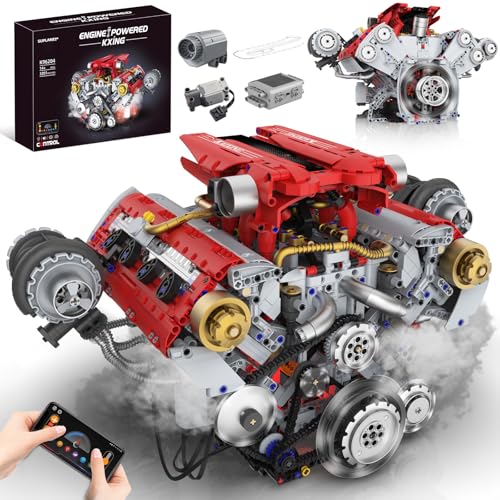
Suplanet offers a large-scale V8 model with lights and sound effects. The design emphasizes visual accuracy and mechanical fidelity, letting observers watch pistons and valves in action without disassembly. A rechargeable power unit supports the LED lighting and motorized elements, enhancing the display experience. With thousands of parts and detailed instructions, it suits experienced builders seeking a high-fidelity, display-worthy engine model that also demonstrates core engine principles.
Mould King 10219 V8 Engine Model Kit

Key features include a high-performance XL motor and a battery box that powers a visible powertrain. The kit enables users to observe piston motion, tune speed via a control lever, and engage a user-friendly interface to tighten drive components. Educational value lies in learning how a real V8 engine coordinates pistons, valves, and timing, while the numbered instruction set supports systematic building for teens and adults who enjoy engineering challenges.
MOCBURIKU V8 Engine Building Set

Designed for serious builders, this 1079-piece kit recreates a high-detail V8 with authentic piston movement, a rotating crank, and a belt-driven accessory system. An L-motor and battery box power the operation, allowing a dynamic demonstration of four-stroke cycles. The kit emphasizes display value, with a dedicated stand to showcase internal mechanisms, making it ideal as a desktop centerpiece for automotive enthusiasts or engineering classrooms.
Franzis 1965 Ford Mustang K-Code 289 V8 Engine Model Kit

This 1:4 scale kit features a clear engine casing so movers and moving parts are visible, with LED lights simulating spark plugs and a spinning fan. A collector’s book accompanies the build, offering historical context and detailed photographs. No glue is required, and the kit includes tools, allowing quick assembly within hours. It emphasizes both educational value and display appeal, particularly for Mustang enthusiasts and scale modeling fans.
Buying Guide: Key Purchase Considerations
- Skill level and age: Some kits are beginner-friendly with step-by-step instructions, while others target advanced builders with complex attachments and electronics.
- Scale, detail, and display: Larger, highly detailed kits are typically designed for display and education, whereas smaller kits emphasize portability and quick setup.
- Power and realism: Look for kits with powered cranks, motors, or battery boxes if you want the engine to actually run, not just appear realistic.
- Electronics and effects: LED lighting, sound, and motion elements add immersion but require power sources and sometimes batteries or chargers.
- Instructions and support: Clear, illustrated manuals and numbering systems help keep the building process smooth; check for online tutorials or customer support if needed.
- Materials and durability: ABS plastics, precise metal parts, and quality fasteners influence durability and the precision of piston movement.
- Display value vs. build time: Some kits are quick to assemble but offer modest display impact; others are long projects that become focal displays.
- Expansion potential: Consider whether the kit includes modular components or compatibility with other building systems for future projects.
- Storage and space: Large kits require ample workspace and organized storage for hundreds to thousands of pieces.
- Educational alignment: For classroom use, prioritize kits with clear explanations of internal combustion principles and downloadable resources.
Overall, selecting the right running V8 engine model kit depends on the builder’s goals—education, display, or a challenging build. The chosen options cover a range of scales, power features, and complexity to suit different interests and skill levels.