Answering the common buyer question: which RV jack blocks deliver reliable leveling on uneven surfaces without fuss? The top picks below emphasize stability, durability, and practical stacking. Ideal for travelers, full-time campers, or weekend warriors who want a solid campsite setup and simple, fast adjustments. Each option is evaluated for best use case, potential limits, and what type of RV or terrain it suits best.
| Product | Best For | Key Benefit |
|---|---|---|
| VEVOR Trailer Jack Block (4-Pack) | General RVs on uneven ground | Increased footprint for stability |
| RVMATE 12 Pack Leveling Blocks | Heavy use & tall rigs | Interlocking design for safe stacking |
| OULEME 12 Pack Leveling Blocks | Budget-friendly multi-pack | Interlocking, durable polypropylene |
| ROBLOCK 6”H Jack Block | Any tongue jack or stabilizer | High-visibility, robust polymer |
| OX BLOX Heavy Duty Trailer Jack Block | Max stability on diverse surfaces | Stackable, up to 10,000 lbs per block |
VEVOR Trailer Jack Block, 6000 lbs Capacity

Best for: RVs on uneven terrain where a larger footprint improves stability. These 4-pack blocks are designed to level and stabilize the tongue jack or stabilizers, reducing wobble on bumpy sites.
Why selected: The blocks emphasize effortless leveling and an enhanced footprint, which translates to better resistance to movement on varying surfaces. They’re stackable for height adjustments and aim to provide a reliable leveling baseline for most travel trailers or campers.
Limitations: Data does not specify exact height increments or interlocking features beyond stacking; verify compatibility with your jack foot shape and groove pattern before use.
RVMATE 12 Pack RV Leveling Blocks

Best for: Large or frequently mobile setups needing robust stability. The interlocking design helps keep stacked blocks aligned, reducing movement during leveling.
Why selected: High-density construction and interlocking tops reduce wear on tires and block bodies. The dimensions (8.5″ square) provide ample surface area and stack height flexibility for multiple rig heights.
Limitations: The data notes 2-pack top covers to prevent tire contact, which may require additional planning if your setup uses unusual wheel dimensions.
OULEME 12 Pack RV Leveling Blocks

Best for: Budget-conscious purchasers who still want interlocking capability and stack height versatility. The 12-block set offers a scalable solution for varying campsites.
Why selected: Made from polypropylene with anti-UV additives and increased density, these blocks are designed to endure outdoor conditions while providing reliable leveling support.
Limitations: Height per block is 1.5 inches; taller sites may require more stacking to achieve level ground, which can add bulk to storage.
ROBLOCK 6”H Trailer Jack Block

Best for: Campers needing a reliable single-pack option with adjustable height capabilities to fine-tune leveling on uneven sites.
Why selected: Features a stackable design with adjustable height and a sturdy polymer body rated for high G.V.W., making it versatile for tongue jacks, posts, and stabilizers.
Limitations: The data emphasizes a single block weight capacity per unit; ensure your trailer weight and jack load align with this rating when stacking multiple blocks.
Hyfico Trailer Jack Block 4 Pack

Best for: Small to mid-size travel trailers needing reliable, compact stacking and storage efficiency.
Why selected: Upgraded design with stable stacking and convenient side holes; uses HDPE with UV resistance for outdoor durability. Each block supports up to 20,000 lbs, offering substantial load capacity for many RVs.
Limitations: Some users may find the 4-pack configuration less flexible than larger multi-pack sets for very tall rigs or extended stays.
Hyfico Trailer Jack Block – 1 Pack

Best for: RVers who want a single-block option for occasional leveling needs or spare setup such as temporary sites.
Why selected: Similar design to other Hyfico blocks with emphasis on stability, anti-water accumulation features, and durable HDPE construction. Compatible with a wide range of jacks and stabilizers.
Limitations: A single-block setup may not provide adequate height for all terrain types; plan for stacking if more height is required.
OX BLOX Heavy Duty Trailer Jack Block
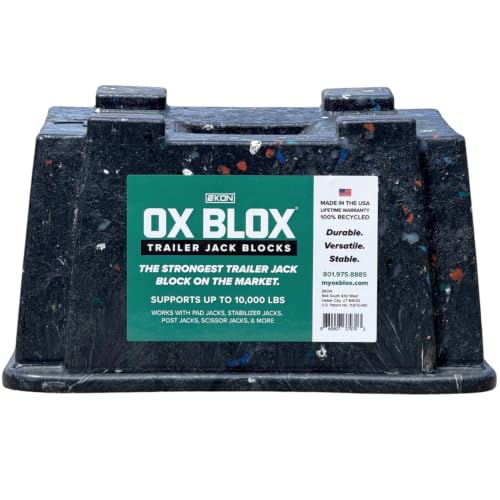
Best for: Campers seeking maximum stability and a high-load option capable of supporting heavy rigs on diverse surfaces.
Why selected: The patented design stabilizes on gravel, grass, dirt, and pavement, with stackable capability for added height. It’s positioned as a robust leveling and stabilizing pad for travel trailers and larger RVs.
Limitations: The emphasis on heavy-duty capacity may make the blocks bulkier to store compared to lighter options; ensure adequate storage space.
Buying Guide: How To Choose RV Jack Blocks
- Load capacity: Check the maximum weight per block and total stack capability to avoid overloading.
- Height range: Consider the expected terrain and how many blocks you’ll need to achieve level ground.
- Material and durability: Polypropylene and HDPE blocks are common; look for UV resistance and weatherproof features for outdoor use.
- Interlocking design: Interlocking tops improve stability by reducing misalignment when stacking.
- Surface compatibility: Ensure blocks suit grass, gravel, dirt, and pavement scenarios you encounter.
- Storage and portability: Assess pack size, included bags, and overall footprint for easy transport.
- Compatibility with jacks: Verify that the block bases accommodate tongue jacks, stabilizers, posts, and wheel jacks typical on your rig.
FAQ
- What is the typical load per block for RV leveling blocks?
Answer: Most blocks are rated from 8,000 to 40,000 lbs per block, depending on the model; confirm the exact rating in the product specs. - Can I use these blocks on soft ground?
Answer: Yes, but on very soft ground you may need additional ground protection or mats to prevent sinking and ensure stability. - Are interlocking blocks safer than non-interlocking types?
Answer: Interlocking designs help keep blocks aligned and reduce shifting, improving stability when stacked. - How many blocks should I carry for a typical RV?
Answer: A combination of 4 to 12 blocks is common, depending on rig height, terrain, and campsite elevation. - Do these blocks work with all types of jacks?
Answer: Most are designed to work with tongue jacks, stabilizers, posts, and various wheel jacks; verify compatibility for your setup. - Is it better to buy a multi-pack or single-pack blocks?
Answer: Multi-packs offer flexibility for different terrains and heights, while single packs are convenient for lighter or spare needs.