If you ride on sandy trails, you need tires designed to bite into loose surfaces while still performing well on hardpack. This guide highlights five sand-friendly dirt bike tires that balance grip, durability, and handling. The selections are best for riders who frequent desert, dune, or beach terrain and want reliable traction at various lean angles. Each product includes why it’s a fit, who should consider it, and a concise caveat to help compare options at a glance.
| Product | ||
|---|---|---|
| WIG Racing Scoop36 110/100-18 | 110/100-18 | Medium-to-soft sand with high lean angles |
| WIG Racing Scoop36 120/90-19 | 120/90-19 | Deeper sand and larger rear leverage |
| WIG Racing 110/90-19 & 80/100-21 | 110/90-19 rear, 80/100-21 front | All-around sand and mixed terrain |
| WIG Racing 120/80-19 Off Road | 120/80-19 | Off-road sand with strong grip on rocks |
| Kenda Big Block K784 110/80B19 & 150/70B17 | 110/80B19 front, 150/70B17 rear | Off-road sand and mixed surface riding |
Note: This table provides a quick overview to help you compare core characteristics. For in-depth section-by-section details, see the product sections below.
WIG Racing Scoop36 110/100-18 Sand Tire

The Scoop36 110/100-18 uses lateral traction scoops on each side for maximum grip at steep angles. It features an auto-release tread design with three paddles that flex to eject debris, maintaining traction in loose sand. The durable intermediate rubber compound protects against damage on hard-pack sections and rocky stretches. Best for riders who prefer a balanced front-to-rear setup on mid-sized bikes and sand-heavy courses.
Who it’s best for: riders seeking predictable cornering on desert trails with consistent debris shedding.
Limitation: smaller 18-inch wheel size may be less common on some models, so verify fitment before purchase.
WIG Racing Scoop36 120/90-19 Sand Tire
This Tire uses the same scoop-and-flex technology as the 110/100-18 but in a larger rear size. The 120/90-19 configuration is optimized for deeper sand and greater weight distribution, helping keep the bike floating rather than bogging down. The 3-piece paddles provide debris shedding to maintain traction on loose surfaces. Best for riders who frequently tackle dunes with bigger rear wheels.
Who it’s best for: riders seeking increased flotation and traction in soft, deep sand.
Limitation: larger rear size can alter ride height and may require suspension adjustments on some models.
WIG Racing 110/90-19 & 80/100-21 Set
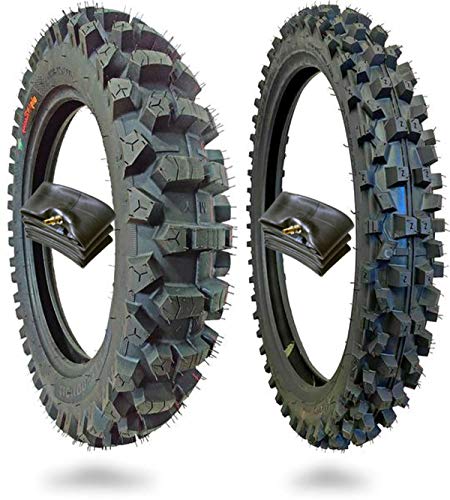
This set includes 110/90-19 rear and 80/100-21 front tires, with 4.10×19 and 2.75×21 inner tubes. The durable intermediate rubber compound provides consistent grip across surfaces. Best for riders seeking a ready-to-run front-and-rear sand setup, especially on bikes designed around 21-inch front wheels.
Who it’s best for: riders wanting a complete, balanced sand-capable package without mixed-brand components.
Caution: check compatibility with the bike’s wheel width to ensure proper fitment and clearance.
WIG Racing 120/80-19 Off Road Tire

The 120/80-19 tire emphasizes off-road traction with a broad contact patch designed for sand and mixed surfaces. The intermediate rubber compound contributes to durability on rough desert trails while maintaining grip. Best for riders who want strong all-terrain performance from a single front or rear tire in sandy environments.
Who it’s best for: riders seeking a generalist all-surface tire that handles sand without sacrificing performance on rocks.
Caution: this size may prioritize grip over top-end speed; consider riding style and terrain mix before selecting.
Kenda Big Block K784 110/80B19 & 150/70B17

The Big Block K784 duo includes 110/80B19 front and 150/70B17 rear tires. It combines aggressive tread with puncture-resistant construction and robust load ratings. Best for riders who want a strong, durable setup capable of handling sand, mud, and mixed terrain, particularly on street-to-off-road transitions.
Who it’s best for: riders needing a versatile pair that performs well on sand and paved sections.
Limitation: two-tire pack may be heavier for lighter bikes; verify wheel sizes and vehicle weight handling before purchase.
Buying Guide: Sand-Tire Essentials
- Terrain balance: For consistent performance on both soft sand and hard pack, prefer tires with a combination of scooped paddles and solid center knobs.
- Wheel size compatibility: Sand tires come in various diameters. Confirm the tire size matches your bike’s wheel rims to avoid clearance issues.
- Rubber compound: Intermediate compounds offer durability on rocks and grip on loose surfaces but can affect wear rate; softer compounds bite better in sand but wear faster.
- Tube vs. tubeless: Some models include inner tubes; choose based on preferred setup and puncture resistance needs.
- Front vs. rear bias: Sand tires on front wheels emphasize steering precision; rear tires influence propulsion and flotation in soft sand.
- Debris release: Auto-release tread designs help shed sand and debris, preventing clogging during long rides.
Frequently Asked Questions
- What tire type is best for sandy dunes? Tires with scooped paddles and a responsive front for steering and a larger rear for flotation are ideal on dunes.
- Can I run sand tires on hard-packed trails? Yes, but expect different wear patterns; some models are optimized for mixed terrain rather than pure sand.
- Do sand tires require inner tubes? Some come with tubes; others are tubeless. Choose based on bike setup and puncture protection needs.
- How do I know if a tire fits my bike? Check the wheel diameter, width, and clearance in the fender and swingarm areas; refer to manufacturer fitment guides.
- Are heavier tires better for sand? Heavier tires can improve flotation but may affect handling and acceleration; balance weight with suspension setup.
- Should I replace both tires at once? For sand riding, a matched front and rear setup improves traction symmetry and handling, but pairing a single new tire with a well-matched used tire can work temporarily.