Answering your search for effective car sound deadening, this guide highlights top options that deliver noticeable cabin quieting. Each product is suited for DIY installers and covers common trouble zones like doors, floors, and trunks. Best for: casual DIY enthusiasts, budget-conscious builders, and those seeking noticeable noise reduction without professional installation.
| Product | Best For | Coverage | Thickness |
|---|---|---|---|
| KILMAT 80 Mil 36 Sqft | Moderate coverage with strong performance | 36 sq ft | 80 mil / 2 mm |
| Siless 80 mil 36 sqft | High-value, reliable performance | 36 sq ft | 80 mil / 2 mm |
| VOISEN 197 mil 31 sqft | Heavy-duty dampening for tight cabins | 31 sq ft | 197 mil / 5 mm |
| RUNSUNSPRI 50 sqft | Large-area quieting for full vehicles | 50 sq ft | Three-layer with butyl/aluminum |
| KILMAT 50 mil 50 sqft | Budget-friendly, easier application | 50 sq ft | 50 mil / 1.3 mm |
KILMAT 80 Mil 36 Sqft Car Sound Deadening Mat

Best for: DIY enthusiasts seeking a thicker, more effective insulation layer. The 80 mil thickness provides higher attenuation potential and is designed for easy application with strong self-adhesive backing. This material benefits smaller to mid-size areas such as doors and floor panels where added mass improves vibration damping. Caution: Heavier sheets may require careful cutting and alignment to avoid air gaps that reduce effectiveness.
80 Mil 10 Sqft Car Sound Deadening Mat

Best for: Small-area upgrades or testing how thicker material impacts noise reduction. It uses the same 80 mil thickness for robust damping in limited spaces like small hatch areas or single door panels. Caution: Limited coverage means you’ll need more pieces to treat larger zones.
Sound Deading Material for Cars 80mil 36sqft (CUKWUYBY)

Best for: Budgets-conscious buyers needing substantial coverage with strong heat reflection. The 8-wire aluminum foil and 2-layer structure offer good heat reflectivity along with vibration damping. Caution: Installation involves multiple components; ensure proper surface prep for best adhesion and long-term performance.
VOISEN Sound Deading Material, 197 Mil (5mm) 31 Sqft
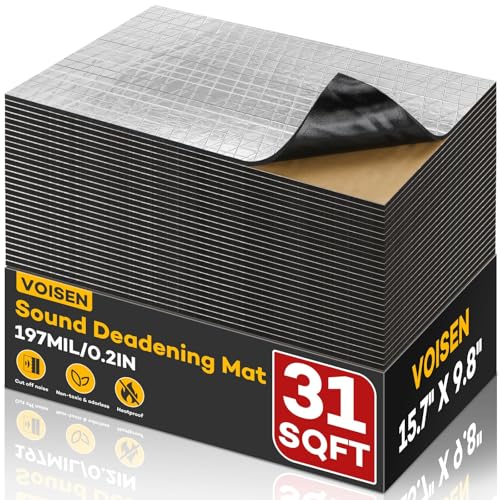
Best for: Vehicles requiring maximum dampening where engine heat and road noise are significant. The 5 mm thick system includes a waterproof aluminum foil surface and a highly compressible foam core for strong vibration absorption. Caution: Higher thickness adds weight and requires more planning for fit in tight spaces.
Siless 80 Mil 36 Sqft Car Sound Deadening Mat

Best for: Car enthusiasts seeking premium performance with solid value. The 80 mil formulation emphasizes vibration damping and noise reduction, targeting noisy panels with a durable, easy-to-cut sheet. Caution: Some users may want additional layers for high-frequency noise reduction in very loud environments.
RUNSUNSPRI Car Sound Deadening 50 Sqft

Best for: Full-vehicle quieting projects where large coverage is needed. The three-layer structure combines butyl, aluminum foil, and a high-adhesion backing for wide-area dampening. Caution: Large sheets may require more time for installation and careful planning around complex interior shapes.
Buying Guide: Key Considerations For Car Sound Deadening
- Material thickness and density: Thicker mats (around 80 mil to 197 mil) generally provide better vibration damping, but weigh more and can be harder to fit in tight spaces. Choose based on your noise sources (low-frequency rattle vs. high-frequency hiss).
- Layer composition: Look for multi-layer designs combining butyl, foil, and adhesive backing. Aluminum foil helps reflect heat while butyl absorbs vibration; this combination improves thermal comfort and cabin quietness.
- Coverage area: Assess the zones to treat (doors, floor, trunk, roof). Larger projects benefit from 50–36 sqft packs, while small fixes can start with 10–20 sqft sheets.
- Adhesion and surface prep: Strong self-adhesive backing requires clean, dry surfaces. Removing debris and ensuring the surface is free of oils improves bond longevity.
- Ease of cutting and shaping: Flexible mats that are easy to cut will save time and improve fit around complex contours and components.
- Heat resistance: If heat exposure is high (engine bay near firewall or hood), heat-reflective surfaces help protect the material and cabin comfort.
- Weight considerations: Heavier mats add damping but increase vehicle weight. Balance quieting benefits with overall weight impact.
Frequently Asked Questions
- Do thicker sound deadening mats always mean quieter cabin?
Not always. Thicker mats improve damping, especially for low-frequency sounds, but proper installation and coverage area are also crucial for overall effectiveness. - Can I install these mats myself?
Yes. Most products are designed for DIY installation with self-adhesive backing. Surface preparation improves adhesion and longevity. - Will these affect interior temperature?
Some mats reflect heat, which can help reduce radiant heat transfer. Proper coverage across roof, firewall, and hood areas can contribute to cabin comfort. - Is one mat type better than another?
It depends on your goals. For budget-friendly, moderate noise reduction, 50–80 mil mats work well. For maximum dampening in a loud environment, thicker mats like 197 mil perform better. - How much coverage do I need for a quiet cabin?
A typical approach targets doors, floors, and trunks first. 20–36 sq ft can significantly reduce road noise in many vehicles; larger vehicles may require 50 sq ft or more for noticeable improvements.