If you need trailer jacks that perform reliably on gravel, these five options stand out for stability, ease of use, and durability. Best for utility trailers, boats, and pop-up campers, each selection targets gravel-friendly mobility and straightforward installation. The top picks are suited for different weights, wheel sizes, and mounting styles to match common trailer tongues and frames.
| Product | Wheel Type / Size | Capacity | |
|---|---|---|---|
| Beach Boat Trailer Jack (FPIGSHS) | 13.38″ rubber-coated iron wheels | 2000 lb | Bolt-On Swivel Tongue Jack |
| Beach Boat Trailer Jack (KINKIBIE) | 10.2″ pneumatic dual wheels | 2000 lb | Bolt-On Swivel Tongue Jack |
| NBJINGYI 6″ Dual Jack Wheel | Dual 6″ wheels | 2000 lb | 2″ Tube Compatible |
| Dutton-Lainson DLx-P Tongue Jack | 8″ wheel | 1500 lb | Swivel with Wheel |
| TOWKING 8″ Wheel Trailer Jack | 8″ wheel, 13″ vertical travel | 2000 lb | Swivel Jack |
Beach Boat Trailer Jack, 13.38in Wheel, 2000lb Capacity

Best for heavy utility trailers and boats that frequently encounter uneven gravel, this 13.38-inch wheel model provides strong load support. It uses a bolt-fixed mounting on a 2.24-inch seamless steel pipe, making installation straightforward for tongue brackets. Best for buyers prioritizing high load capacity and easy replacement of wheels when navigating gravel paths. Limitations: bolt-on installation may require basic hardware tools and a compatible tongue bracket.
Beach Boat Trailer Jack for 10″ Wheel, 2000 lb

Better for boats and utility trailers that benefit from a dual 10″ pneumatic wheel setup, this option supports up to 2,000 lb with corrosion-resistant steel construction. Choose this if you need more ground contact for soft gravel and uneven surfaces. Caution: heavier weight and larger wheel size may require more space for storage and installation.
NBJINGYI 6″ Dual Trailer Jack Wheel

Best for light-to-midweight pop-up campers and compact trailers, this 6″ dual-wheel design improves stability on gravel due to greater ground contact. It supports up to 2,000 lb and fits standard 2-inch trailer jack tubes. Limitation: smaller wheel diameter may struggle on very loose gravel without a robust frame or additional stabilizers.
Dutton-Lainson DLx-P Tongue Jack with Wheel
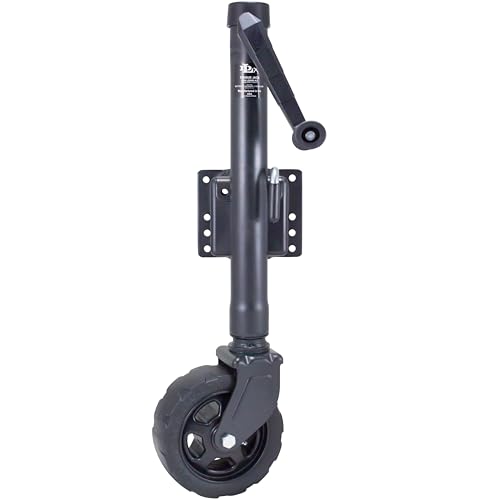
Best for boat and trailer setups requiring robust corrosion resistance and a swiveling wheel design for gravel surfaces. It offers 1,500 lb capacity and 12″ total travel, with a wheel bracket that rotates for versatile maneuvering. Choose this if you need a US-made option with reinforced hardware. Caution: weight capacity is lower than some larger trailers, so match to your load.
TOWKING 2,500-lb Dual 6″ Wheel Jack

Best for heavy-duty trailers and boats that require stable rolling on gravel, this 2,500 lb-rated dual-wheel design enhances weight distribution and ground contact. It attaches to a standard 2″ jack tube, offering easy upgrades for gravel-friendly mobility. Limitation: higher capacity units may be bulkier, requiring more storage space.
TOWKING 8-inch Wheel Trailer Jack

Best for mid-sized trailers and RVs moving over gravel, this jack features an 8″ wheel with 13″ vertical movement and a 2,000 lb capacity. It is well-suited for gravel surfaces due to a larger wheel footprint and stable rolling. Choose this if you prioritize longer lifting range and smoother travel on rough terrain. Caution: ensure your tongue height and frame dimensions match the jack’s travel range.
Buying Guide
- What wheel size do I need for gravel? Larger wheels distribute weight more evenly and resist sinking into soft gravel. Consider 8″ or larger wheels for rough or loose gravel.
- What load capacity is required? Match the jack’s capacity to the trailer’s tongue weight and total load. Avoid undersizing, which can lead to instability.
- Fixed bolt-on vs. bolt-on swivel: Swivel wheels offer better maneuverability on uneven surfaces, while fixed mounts can be simpler to install and more robust for heavy use.
- Ground clearance and travel: If you need to raise the trailer high off the ground, choose a jack with greater vertical travel. Ensure it fits your frame height and storage space.
- Frame compatibility: Verify tube diameter (common is 2″) and mounting pattern. Some jacks fit universal tubes; others require precise brackets.
- Material and corrosion resistance: For outdoors and salt-prone areas, look for powder coating, galvanizing, or zinc plating to extend life in gravel and wet conditions.
FAQ
- Q: Are larger wheels always better on gravel? A: Larger wheels improve ground contact and reduce sinking, but must fit your trailer’s frame and tongue height.
- Q: Can I replace just the wheel on a jack? A: Many jacks allow wheel replacement, but confirm wheel size, bore, and compatibility with your model.
- Q: Is a swivel wheel necessary for gravel? A: Swivel wheels enhance maneuverability on uneven surfaces, especially in tight spaces or garages.
- Q: What is tongue weight and how does it affect jack choice? A: Tongue weight is the load on the hitch; choose a jack with capacity exceeding the tongue weight plus cargo.
- Q: How should I install a bolt-on jack? A: Follow manufacturer instructions; typically requires brackets, bolts, and basic tools to secure the jack to the trailer tongue.
- Q: Do all jacks work on soft or muddy gravel? A: Heavier, wider wheels and corrosion-resistant construction help, but in extremely soft ground you may need auxiliary stabilizers.