Answering the need for a dependable water supply on the road, these travel trailer water pumps provide steady pressure for showers, sinks, and onboard sprayers. They’re best for RV owners who want quick-on-demand water without manual priming, whether you’re cruising off-grid, camping at a site with marginal water pressure, or simply upgrading an aging pump. The top picks below cover compact 12V models for on-site battery power, plus a 110V option for shore power scenarios. Use this guide to compare flow, shut-off pressure, noise, and installation ease.
| Product | Type | Flow | Pressure | Best For |
|---|---|---|---|---|
| WASSERMANN RV Pump | 12V Diaphragm | 4.0 GPM | 45 PSI | Standard RV use with 12V power; reliable for campers |
| ECO-WORTHY RV Fresh Water Pump | 12V DC Diaphragm | 3.5 GPM | 45 PSI | On-demand flow with adjustable range; good for small to mid setups |
| Gidrox 12V RV Water Pump | 12V Diaphragm | 4.0 GPM | 45 PSI | Quiet operation; off-grid readiness with dual safeguards |
| MAXZONE RV Fresh Water Diaphragm Pump | 12V Diaphragm | 4.0 GPM | 50 PSI | On-demand, safe operation with overload protection |
| SEAFLO 33 Series 110V | 110V AC Diaphragm | 3.3 GPM | 45 PSI | Shore-power RVs and boats needing high reliability |
WASSERMANN RV Pump

The WASSERMANN RV Pump provides a compact 12V self-priming option with 4.0 GPM and 45 PSI. It ships as a complete kit, including hose adapters, a debris filter, and a user manual. Best for RVs and campers that rely on battery power and want a straightforward installation with essential fittings included. This model emphasizes strong flow and stable pressure for everyday water use on the road. A potential limitation is that performance depends on battery health and wiring quality; ensure you have a reliable 12V power source and proper wiring to avoid short cycling.
ECO-WORTHY RV Fresh Water Pump

The ECO-WORTHY unit is a 12V self-priming diaphragm pump rated at 3.5 GPM with a 45 PSI switch. It features an adjustable pressure range (35-80 PSI) and an automatic on-demand function, meaning flow starts when a faucet opens. It includes safety features like thermal overload protection and dry-run tolerance. This pump is well-suited for smaller to mid-sized RV setups where adjustable pressure helps manage water usage. A caveat is that the maximum lift and head might require careful hose routing if you have vertical runs in your plumbing.
Gidrox 12V RV Water Pump

Gidrox offers a 4.0 GPM, 45 PSI diaphragm pump with self-priming capability and a quiet operation profile thanks to vibration-damping features. It emphasizes off-grid readiness with dual safeguards, including overheating protection. This choice is best for RVers who value low noise and reliable performance in remote locations. A limitation to watch is that installation must accommodate its 100 ft head rating and ensure the pump remains well-ventilated to avoid heat buildup in enclosed compartments.
Shurflo 12V RV Water Pump

Shurflo’s 12V model is a dependable option with 3.0 GPM capacity. Note the listing includes a disclaimer that liquid from factory testing may be present, which is common for some new units. This pump is best for owners who need a straightforward, widely compatible unit and don’t require the highest flow. The absence of detailed specifications beyond the basic flow and the caution about test fluid should be considered when planning installation and service intervals.
MAXZONE RV Fresh Water Diaphragm Pump
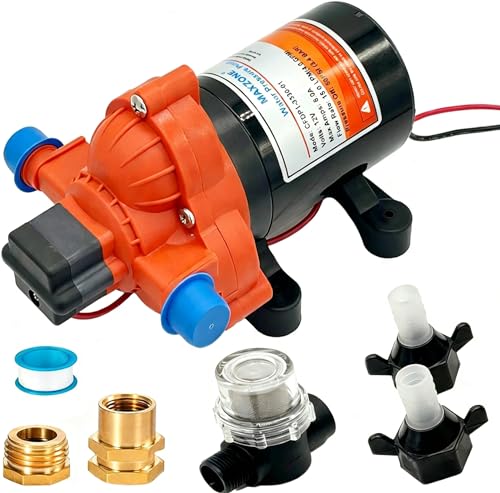
MAXZONE offers a 4.0 GPM, 50 PSI diaphragm pump with on-demand pressure control and a safety note about not adjusting the pressure screw. It includes a 12V motor, anti-overload protection, and recommended wiring guidelines. This choice suits RV owners who want a balanced mix of flow, pressure, and protective features to extend pump life. A limitation is the need to follow the wiring and fuse guidance precisely to prevent electrical issues.
SEAFLO 33 Series 110V Fresh Water Pump

SEAFLO’s 110V version provides 3.3 GPM at 45 PSI and is built to NSF/UL standards for potable water. It’s an excellent option for RVs or boats with reliable shore power, offering a robust warranty and compatibility with standard 1/2″ tubing. The key advantage is consistent high-quality performance under AC power, while the caveat is dependency on 110V electrical availability and potentially higher installation complexity compared with 12V units.
Buying Guide: Key Considerations For Travel Trailer Water Pumps
- Power source: Choose 12V for off-grid RVs or 110V for shore-powered setups. Confirm your battery capacity and wiring can support continuous operation.
- Flow rate and pressure: Match 3.0–4.0 GPM with 45–50 PSI for typical showers and sinks. Higher PSI helps with long runs but may increase cycling.
- Self-priming and head height: Ensure the pump can prime from a standing start and handle vertical lifts; check head height ratings for your plumbing runs.
- Noise and vibration: Look for rugged housings and vibration-damping features if the pump sits near living spaces.
- Protection features: Thermal overload protection and dry-run tolerance extend pump life in fluctuating RV conditions.
- Ease of installation: Kits with included adapters and strainers simplify setup and reduce leaks.
- Safety standards: For potable water, consider NSF/UL-compliant models when available to ensure water safety compliance.
Frequently Asked Questions
- What is the typical GPM needed for RV showers?
Most RV showers run efficiently around 3.0–4.0 GPM, with 45–50 PSI providing comfortable pressure.
- Do 12V pumps work off a car battery?
Yes, 12V pumps are designed to run on RV house batteries or connected 12V power sources, with appropriate fuse protection.
- Is a higher PSI always better for RV water systems?
Not always. Higher pressure can cause water hammer and pump wear; set the switch to a suitable range for your plumbing and fixtures.
- Should I choose a 110V pump for an RV?
Choose 110V if you have reliable shore power and want a more classic, stationary setup. It increases installation considerations but can offer consistent performance.
- What maintenance is needed for RV water pumps?
Regular inspection of fittings, strainers, and hoses; replace worn seals, and ensure debris filters stay clear to prevent flow restriction.