When you need reliable wheel chocks to secure a vehicle during winching or towing, choose blocks designed for heavy weight, strong grip, and all-weather performance. This guide highlights five top options, showing who each is best for and why. Ideal buyers include RV owners, trailer users, and DIY enthusiasts who work on trucks or boats and require dependable stability in varied conditions.
| Product | Brand | Best For | Key Benefit |
|---|---|---|---|
| MaxxHaul Solid Rubber Wheel Chock 2-Pack | MAXXHAUL | Cars, trucks, trailers, RVs | Durable rubber with all-weather performance |
| Wheel Chocks for RV Trailer Camper Truck Car (4-pack) | WECARLLE | RVs, trailers, boats, campers | Reflective strips for visibility; versatile use |
| Wheel Chocks for Cars, RVs, Trucks, Trailers (4-Pack) | AFA Tooling | Full axle chocking; dual wheels | Dual-wheel set with easy handles and ties |
| MaxxHaul 50011 Heavy-Duty Rubber Wheel Chocks (2 Pack) | MAXXHAUL | Trailers, RVs, trucks | Eyebolt design for easy handling and rope attachment |
| Komokeru Wheel Chocks for RV Trailer (4 Pack) | Komokeru | RV, trailer, camper, travel vehicles | Non-slip design with rope for removal |
MaxxHaul Solid Rubber Wheel Chock 2-Pack

Best for heavy-duty, all-weather stability. Made from solid rubber to resist cracking and deformation, these chocks provide dependable support for cars, trucks, trailers, and RVs. The compact 8″ x 4″ x 6″ size fits behind tires or in storage compartments and supports use in rain, snow, and oil.
- Best for: Vehicles needing rugged, weather-resistant support.
- Why selected: Durable construction, compact footprint, reliable grip on oily or wet surfaces.
- Caution: Rubber wear may occur in extreme heat or UV exposure over long periods.
Wheel Chocks for RV Trailer Camper Truck Car (4-Pack)

Best for versatile applications across RVs, trailers, and boats. This 4-pack uses premium rubber blocks with non-slip functionality and optional reflective strips for better visibility. Suitable for parking, loading, and securing during maintenance.
- Best for: RVs, trailers, and boats in varied environments.
- Why selected: Reflective strips increase visibility; solid grip on diverse surfaces.
- Caution: Visual visibility may vary in low-light conditions without external lighting.
Wheel Chocks for Cars, RVs, Trucks (4-Pack) By AFA Tooling
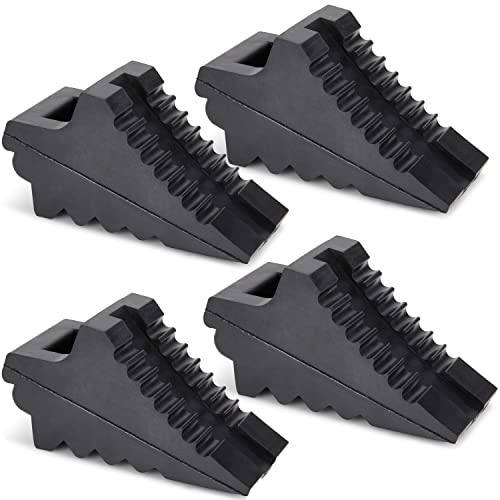
Best for dual-wheel chocking and easy handling. These wheel chocks are sized for vehicles up to 8 tons GVW and come as a 4-pack to quickly chock both front and rear axles. Handles and rope ties facilitate pairing and removal.
- Best for: People who want ready-to-use dual-wheel protection.
- Why selected: 4-pack for quick stabilization of both axles; easy handling.
- Caution: Larger vehicles may require bigger chocks than this set provides.
MaxxHaul 50011 Heavy-Duty Rubber Wheel Chocks

Best for robust, weather-ready performance. These chocks feature a built-in eyebolt design for easy handling and optional rope attachment, plus a heavy-duty rubber construction for long-term stability in heat, cold, and moisture.
- Best for: Trailers, RVs, and trucks requiring a secure anchor and simple removal.
- Why selected: Eyebolt option enhances handling; traction pad improves grip.
- Caution: Eyebolt holes should be inspected for wear to maintain secure attachment.
Komokeru Wheel Chocks for RV Trailer (4 Pack)

Best for lightweight, easy removal with a non-slip design. These plastic wheel chocks include a rope for quick removal and a handle strap for simple placement, ideal for travel trailers, campers, and cars on uneven ground.
- Best for: Lightweight setups and easy transport in limited space.
- Why selected: Non-slip bottom design provides stable grip; rope aids removal.
- Caution: Plastic chocks may wear faster under heavy, repeated use in extreme temperatures.
Buying Guide
What material should you choose?
Rubber chocks offer durability and strong grip, especially on oily or wet surfaces. Plastic or composite chocks are lighter and easy to handle, but may wear more quickly under heavy use or extreme weather. For winching scenarios, rubber or reinforced plastic with non-slip bases is typically advisable.
What size is right for your vehicle?
Size matters for stability and clearance. Larger vehicles (RV, trailers, trucks) require bigger blocks with broader contact areas. Smaller cars fit compact chocks. Check the GVW rating and tire width to match the chock dimensions to your load.
Grip and grip aids
Look for textured or coated traction pads and low-profile wedges. Some products include built-in eyebolt handles or rope ties to simplify stabilization and removal after winching. Reflective strips can improve visibility in poor lighting.
Ease of use and accessories
EyebOLT designs or rope-ready chocks streamline handling. Handles, lanyards, and storage features help when you need to deploy quickly during tire changes or recoveries. Consider whether you want to stack or pair chocks for dual-wheel service.
Weather and environment considerations
Consider UV resistance, oil resistance, and temperature tolerance. All-weather chocks function across rain, snow, sun, and heat. If you operate near water or humidity, selecting non-corrosive hardware (no rust-prone metal parts) is wise.
Safety tips and best practices
- Place chocks on firm, level ground before winching or lifting.
- Chock wheels on both sides of the tire when possible.
- Use chocks in combination with other stabilizing methods when necessary.
- Inspect chocks regularly for cracks, wear, or softened rubber.
Frequently asked questions
- Q: Can wheel chocks be used on any surface? A: They work best on firm, level surfaces; uneven ground may reduce effectiveness unless the chocks are specifically designed for it.
- Q: Are metal chocks better than rubber? A: Metal can offer strength but may slip on oily surfaces; rubber or rubber-infused chocks provide better grip in wet conditions.
- Q: How many chocks should I use? A: For most vehicles, use at least two—one on each side of the wheel being secured; use four for dual-wheel stabilization when possible.
- Q: Do chocks require maintenance? A: Yes, inspect for cracks, chunks missing, or hardening of rubber; replace if any damage is found.
- Q: Is a rope or handle essential? A: Rope or handles aid removal and pairing of dual-chock setups, especially in confined spaces or under load.
- Q: Can I rely on chocks alone during winching? A: Chocks are a stability aid; do not rely on them as the sole restraint tool in risky winching or lifting operations.