When choosing wheelchair restraints for vans, the top priority is reliable, fast-securement that works with standard L-Track floors. This guide highlights five proven options designed for NEMT fleets, paratransit services, school buses, and WAV conversions. Each product explains who it’s best for, why it stands out, and any practical limitations. Read on to compare features such as Positive Lock Indicators, single-tension operation, and compatibility with common vehicle models.
Buyer snapshot: the following table provides quick comparisons to help you decide which system best fits your fleet or personal WAV conversion.
| Product | Best For | Key Benefit | Notes |
|---|---|---|---|
| Q’Straint Q-8201-L QRT Standard 4-Pack | NEMT, paratransit, school buses | Semi-automatic tensioning with PLI | Four-point kit for floor L-Track |
| Q’Straint QRT STANDARD for L Track PN: Q-8201-L | Fleet operations, wide vehicle range | Single tensioning knob, clear locking indicator | Interchangeable design, L-Track compatible |
| Q’Straint Q-8200-A-L QRT Standard Kit | WAV conversions, fleets with footrest clearance concerns | Complete four-point kit with occupant belt | Bracketless, low-profile design |
| Q8-6325 Lap Belt | Supplemental occupant restraint | Direct rear tether and adjustable webbing | Push-button buckle |
| WOTS Wheelchair Securement Tie-Down | Lightweight, corrosion-proof option | Auto-retractable and ISO/J2249 compliant | Aluminum/steel construction |
Q’Straint Q-8201-L QRT Standard 4-Pack

The complete four-point securement kit uses four QRT Standard retractors designed for floor L-Track anchorage. It supports securement of one wheelchair or mobility scooter and is suitable for NEMT, paratransit, and school bus environments. The Positive Lock Indicator (PLI) confirms a locked, safe fit, reducing driver guesswork. Semi-automatic tensioning with a single-tension knob lets operators tighten with one hand, ideal for busy fleets or ambulatory drivers. Best for fleets that require a fast, dependable setup with clear visual confirmation.
Best for: NEMT and paratransit operations that prioritize visual confirmation of lock and quick, one-handed tightening. Caution: assembly requires compatible L-track floors; ensure floor rails are present and correctly installed.
Q’Straint QRT STANDARD for L Track PN: Q-8201-L

This variant emphasizes interchangeability and a single tensioning knob for fast securement, making it well-suited for fleets with multiple vehicle types. The Positive Lock Indicator ensures the operator can visually verify that the fitting is properly locked in L-track anchorage before movement. The all-in-one design reduces the need for left-right-front-rear distinctions, simplifying loading in high-volume environments. Better for managers who value consistent tension and minimal driver training time.
Best for: Operations needing a consistent, fast setup across different vehicle models. Caution: ensure all vehicles use compatible L-track anchors to avoid fit issues.
Q’Straint Q-8200-A-L QRT Standard Wheelchair Tie Down Kit

This kit combines four Q8-6201-L retractors with PLI L-Track fittings and includes an occupant securement unit plus mounting brackets and installation materials. It’s designed for WAVs, paratransit vans, and a wide range of vehicle types, including ProMaster, Sprinter, and similar platforms. The PLI system provides clear visual confirmation of lock, while the low-profile design helps accommodate footrests and other vehicle features. Choose this if you need a comprehensive WAV securement bundle for multiple vehicle types.
Best for: WAV conversions and fleets that want a complete kit with mounting brackets and instructions. Caution: L-Track rails must be compatible with the included fittings; verify rail length and spacing before purchase.
Q8-6325 Standard QRT Lap Belt

This lap belt attaches directly to rear tie-downs, ensuring vehicle-compliant mounting with adjustable webbing for fit around the occupant. The push-button buckle supports quick fastening and release, complementing four-point systems for added occupant restraint. Best for: augmenting primary restraints with an occupant belt designed for easy use and reliable rear attachment. Limitation: belt adjustments rely on webbing length and mounting geometry; ensure compatibility with chair or scooter dimensions.
WOTS Wheelchair Securement Tie-Down
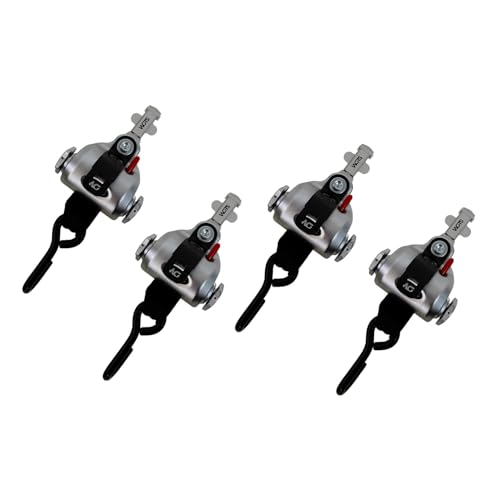
WOTS offers a lightweight, corrosion-resistant option featuring auto-retractable and auto-tightening mechanisms. The construction blends aluminum and steel for strength, while ISO 10542 and SAE J2249 compliance emphasize safety. Best for: users seeking a lighter system with reduced maintenance and strong, corrosion-resistant components. Caution: ensure compatibility with your vehicle’s L-track spacing and footrest clearance, as some WAV configurations may require adjustments.
Quick-Secure Retractable Tie Downs

Safe Haven offers a four-pack of L-Track retractable straps with an included user manual. The system provides straightforward installation and a reliable tie-down solution for standard L-Track configurations. Best for: buyers who want a simple, no-fruss setup with clear instructions. Caution: verify that the included mounting hardware is compatible with your vehicle’s floor track and wheelchair frame.
MENURSY Standard Retractable Wheelchair System
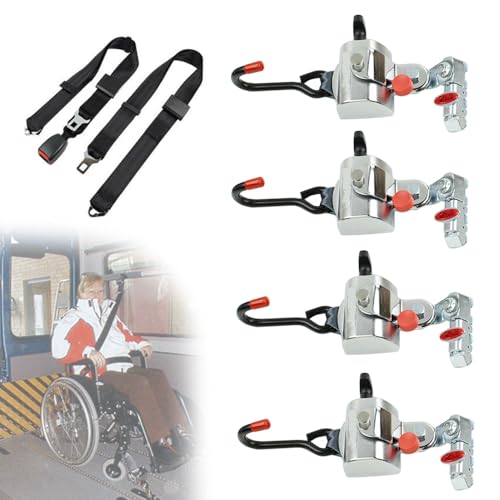
MENURSY’s system is designed for transit and paratransit vehicles, using a semi-automatic tensioning approach within L-track frames. It emphasizes compatibility with various vehicle types, including vans and buses, and aims to maintain consistent securement throughout transport. Best for: fleets needing a versatile, semi-automatic retractor system that fits a broad range of L-track installations. Caution: confirm that your vehicle’s L-track spacing aligns with the kit’s rail fitment and length.
Buying Guide
Key purchase considerations for wheelchair restraints in vans include compatibility, ease of use, and securement strength.
- Track compatibility: Ensure your vehicle uses L-Track ground anchorage and verify rail length, spacing, and mounting brackets before buying a kit.
- Lock indicators and tensioning: Positive Lock Indicator (PLI) and single-tension designs reduce loading time and provide visual confirmation for driver safety.
- Complete kits vs. parts: Four-point systems with occupant belts and mounting hardware offer a ready-to-install solution, while individual retractors require additional components.
- Weight and installation: Lighter systems may ease installation in smaller WAVs, but must maintain durability and meet safety standards.
- Warranty and maintenance: Prefer kits with straightforward maintenance, minimal electronics, and clear warranty terms to minimize downtime.
Frequently Asked Questions
- What is the primary purpose of these restraints in vans?
They prevent wheelchair movement during transit, protecting occupants and drivers. - Do all these systems work with every WAV?
Most are designed for standard L-Track floors; confirm vehicle compatibility before purchase. - What is PLI and why is it important?
PLI stands for Positive Lock Indicator; it visually confirms the retractor is locked, improving safety and reducing operator error. - Are these systems easy for drivers to use?
Many options feature a single tensioning knob for quick, one-handed operation, which helps with busy schedules. - Should I buy a complete kit or mix-and-match parts?
Complete four-point kits with mounting hardware simplify installation and ensure compatibility. - What about installation time?
Semi-automatic and single-knob designs typically shorten securing time compared to traditional systems.