Looking for a reliable code reader for trucks that works across 1996+ OBDII vehicles and heavy-duty applications? This guide highlights five versatile options, explaining who each is best for, and why they stand out for truck owners, fleet shoppers, and DIY enthusiasts. The top picks cover broad compatibility, live data, code reading/clearing, and features like EVAP checks, ABS/SRS support, and battery testing. A quick buyer table below helps you compare at a glance.
| Product | Best For |
|---|---|
| ANCEL AD310 | General truck maintenance, quick CEL diagnosis, budget-friendly |
| ANCEL AD410 | All-around diagnostics for 1996+ OBDII and CAN, advanced tests |
| FOXWELL NT301 | Live data visualization, basic to mid-level diagnostics |
| VDIAGTOOL VD10 | DIYers who want easy code reading and DTC lookup |
| MOTOPOWER MP69033 | Wide protocol support with clear display and multilingual support |
ANCEL AD310 Classic Enhanced Universal OBD II Scanner

The ANCEL AD310 is a compact, budget-friendly diagnostic tool designed to read and clear emission-related codes on 1996 and newer OBDII vehicles. It supports live data, freeze frame, I/M readiness, and vehicle information readouts. This model is praised for fast results and straightforward operation, making it a solid choice for owners who want a simple, reliable tool for routine truck maintenance. Best for budget-conscious buyers who want quick fault code checks without advanced system testing.
Who this is best for: fleet operators or independent truck owners who need a portable, dependable scanner for routine checks. Why selected: strong core functionality, simple interface, and direct on-car power from the OBDII port.
Caution: It’s primarily an engine/OBDII code reader; it does not replace more advanced OEM diagnostics for ABS, transmission, or complex subsystems.
ANCEL AD410 Enhanced OBD2 Scanner

The AD410 is a wider-compatibility OBDII scanner that supports 1996 US, 2000 EU/Asia models, plus CAN vehicles. It features a comprehensive code library with over 42,000Lookup entries, enabling easy identification of faults and I/M readiness checks. It can clear faults after the root issue is addressed and includes enhanced diagnostics like EVAP testing and O2 sensor checks. Best for truck owners who need broad compatibility and expanded diagnostic capability in one handheld device.
Best for: drivers who frequently encounter emissions-related problems and want a single tool with robust DTC lookup. Why selected: extensive code database and EVAP/O2 testing capabilities enhance troubleshooting for on-the-road fleets.
Limitation: This model is described as primarily an engine code reader; it does not support ABS/SRS or some heavier vehicle systems in certain configurations.
FOXWELL NT301 OBD2 Scanner

The FOXWELL NT301 focuses on live data, fault code reading, and basic diagnostics for most 1996+ gasoline vehicles, light trucks, and SUVs. It offers graphing of live data, which helps track sensor trends and identify intermittent problems. It does not support ABS, SRS, EPB, or A/C systems in many models, making it a practical choice for straightforward engine diagnostics and quick CEL clearance. Best for: users who want a simple, reliable tool with clear live data visualization.
Why chosen: strong live data capabilities and a straightforward interface make it a practical mid-range option for truck owners who want more than just code reading without venturing into full system diagnostics.
Caution: Not all systems (ABS/SRS/etc.) are supported; verify vehicle compatibility before relying on it for comprehensive diagnostics.
VDIAGTOOL VD10 OBD2 Scanner
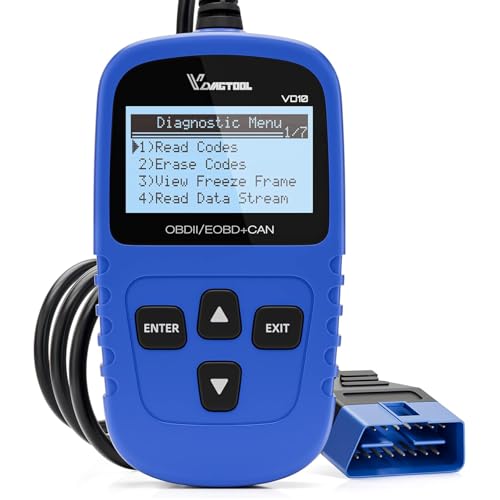
The VDIOGTOOL VD10 is a practical do-it-yourself diagnostic tool that reads codes, clears them, and provides DTC definitions from a built-in database of more than 3000 codes. It also supports viewing live data, freeze frame, I/M readiness, and vehicle information. This makes it a solid all-around option for owners who want instant definitions on screen and a simple, readable interface. Best for: DIYers who want a compact, reliable reader with a strong DTC lookup library.
Selected for: ease of use and quick fault-code interpretation without online lookups. Caution: As with many entry-level tools, more advanced diagnostics (ABS/SRS, steering/suspension diagnostics) may require a higher-end scanner.
MOTOPOWER MP69033 Car OBD2 Scanner

The MOTOPOWER MP69033 is a versatile OBDII scanner with nine protocol support, a clear 2.8″ LCD display, and multilingual support. It reads and erases codes, shows live data, and offers I/M readiness and basic vehicle information. Its broad protocol compatibility makes it suitable for a wide range of trucks and SUVs, including newer CAN vehicles. Best for: truck owners who want a simple, readable screen and broad language options for diverse fleets.
Why selected: strong performance across many regions and clear presentation on a dedicated LCD screen aid quick on-the-spot diagnosis.
Caution: The device relies on the vehicle’s OBDII port; ensure your truck’s port is accessible and that the model supports your exact year and region for best results.
Buying Guide: What To Consider When Selecting A Truck Code Reader
Compatibility: Confirm the scanner supports your truck’s year range, engine type, and CAN/OBDII protocols. If you own multiple vehicles, prioritize a model with broad compatibility and a large database of DTC definitions.
Diagnostics Depth: Decide between basic code reading and deeper diagnostics like ABS/SRS, EVAP, and live data. Heavy-duty trucks or fleet maintenance may require advanced features and robust data visualization.
Ease Of Use: For DIY users, a clear interface and an accessible screen (or smartphone integration) can reduce setup time. Look for devices with live data graphs, freeze-frame, and auto-code lookup to speed up troubleshooting.
Power Source: Some scanners draw power from the vehicle (OBDII port) and don’t require an internal battery. Others use rechargeable batteries or USB power; choose based on how you plan to use the device away from the cab.
Language And Localization: If you operate in multilingual contexts or in fleets across markets, consider scanners with multilingual support and region-specific DTC definitions.
Future-Proofing: Check software update policies and whether the device can be updated to support new vehicle families or enhanced diagnostic routines in the future.
Frequently Asked Questions
- Do truck owners need a professional-grade scanner? Not necessarily. For routine maintenance and basic CEL checks, a mid-range OBD2 scanner usually suffices. For advanced diagnostics or ABS/SRS testing, a higher-end tool may be warranted.
- Can I use a truck scanner with multiple brands? Yes, most OBDII scanners support vehicles from 1996 onward across major brands, but always verify model-year and region compatibility before purchase.
- Will these scanners clear codes after repairs? Most do. Clearing codes is common once underlying issues are resolved, but some devices note that clearing codes does not fix the issue itself.
- Do I need a subscription for these tools? Several models offer free DTC lookups and basic features without subscriptions, though some advanced features or repair reports may require a paid plan.
- Is live data important for trucks? Live data helps monitor engine parameters in real time, which is valuable for diagnosing intermittent problems and validating repairs on heavy-duty jobs.
- How do I check compatibility with my truck? Use the product’s model-year compatibility notes and confirm with the vehicle’s service manual or dealer if you’re unsure.